
What Can Void a Three-Day Notice to Pay or Quit? Common Mistakes & Fixes 2026
Dealing with unpaid rent is one of the toughest parts of being a landlord. When a tenant misses a payment, a three-day notice to pay or quit is often the first step to resolve the issue or start the eviction process. But here’s the catch: if this notice isn’t done right, it can be voided, delaying your ability to collect rent or regain your property.
A three-day notice to pay or quit can be voided by errors like wrong rent amount, improper service, unclear deadlines, or state law violations.
What is a Three-Day Notice to Pay ?
A three-day notice to pay or quit is a formal written document landlords send to tenants who haven’t paid rent on time. It gives the tenant three days to either pay the overdue rent in full or move out of the property. If the tenant does neither, the landlord can file an eviction lawsuit, often called an unlawful detainer in legal terms. This notice isn’t an eviction itself but a critical step that sets the stage for legal action if needed.
The notice serves a few key purposes:
- Notifies Tenants: Clearly tells the tenant they owe rent and need to act fast.
- Legal Documentation: Creates a record of the landlord’s attempt to resolve the issue, which is crucial for court.
- Encourages Resolution: Pushes tenants to pay up or negotiate before things escalate.
The rules for issuing a three-day notice vary by state, but they all require precision. Mistakes can void the notice, forcing you to start over. Let’s dive into what can go wrong and how to avoid it.
What Can Void a Three-Day Notice ?
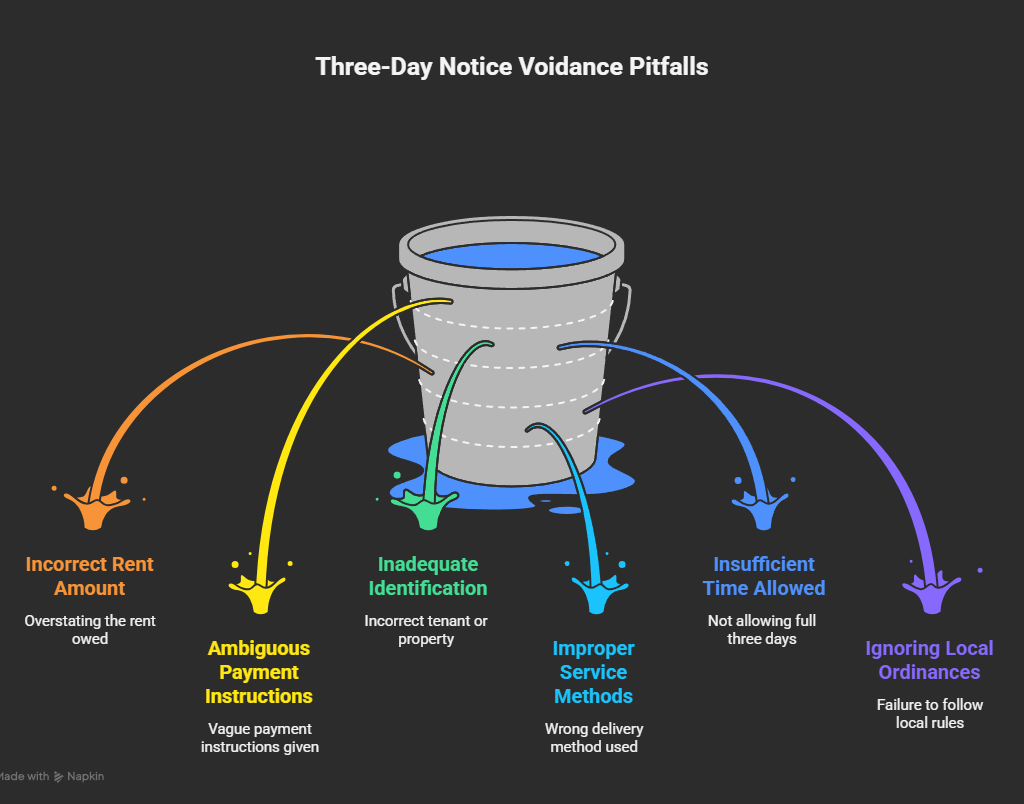
A three-day notice is a legal document, so even small errors can make it invalid. If the notice is voided, you may need to restart the process, costing you time and money. Here are the most common reasons a three-day notice can be voided, with details to help landlords steer clear of these pitfalls:
1. Incorrect Rent Amount Stated
The notice must list the exact amount of overdue rent. If you:
- Overstate the rent owed (e.g., including future rent not yet due).
- Include non-rent fees (like late fees or utilities) unless the lease explicitly allows it.
- Miscalculate the amount due to errors in accounting.
The notice can be challenged and voided. For example, in California, including late fees in the rent amount (unless permitted by the lease) can invalidate the notice. Always double-check your records and stick to the rent amount owed for the period in question.
2. Ambiguous or Incorrect Payment Instructions
The notice must clearly explain how and where the tenant should pay the rent. Vague instructions (e.g., “Pay me somehow”) or incorrect details (like an outdated bank account) can lead to disputes. For instance, if you don’t specify acceptable payment methods (cash, check, online transfer) or provide the wrong address for payment, a tenant could argue they couldn’t comply, voiding the notice.
3. Inadequate Identification of Property or Parties
The notice must accurately identify:
- The rental property (full address, including unit number if applicable).
- The tenant(s) named in the lease.
If you list the wrong address or misspell a tenant’s name, the notice may be deemed invalid. For example, if multiple tenants are on the lease, all names must be included. A missing or incorrect detail can give tenants grounds to challenge the notice in court.
4. Improper Service Methods
Each state has strict rules about how to deliver a three-day notice. Common methods include:
- Personal Delivery: Handing the notice directly to the tenant.
- Substituted Service: Leaving it with another adult at the property and mailing a copy.
- Posting and Mailing: Posting the notice on the property (e.g., on the door) and mailing a copy, often as a last resort.
If you use the wrong method or fail to provide proof of service (like a certified mail receipt), the notice can be voided. For example, in Florida, improper delivery (e.g., not following posting rules) can invalidate the process.
5. Not Allowing the Full Three Days
The three-day period starts the day after the notice is served, and it typically includes only business days (weekends and holidays may not count, depending on the state). If you:
- Demand payment in less than three full days.
- Serve the notice late in the day and count that day as part of the three days.
The notice may be voided. For instance, in Ohio, the three-day period must be strictly adhered to, or the tenant can argue they weren’t given enough time.
6. Failure to Follow Local Ordinances
Some cities or counties have extra rules, like rent control or tenant protections during emergencies (e.g., pandemics or natural disasters). Ignoring these can void a notice. For example, in California, certain cities have rent control laws that add requirements for notices, and failing to comply can make the notice invalid.
7. Accepting Partial Payments
If you accept any payment (even partial) after issuing the notice, it can void the notice in many states. For example, in California, accepting partial rent after serving a three-day notice may require you to issue a new notice, restarting the process. To avoid this, clearly communicate that you won’t accept partial payments unless you’re willing to pause the eviction process.
8. Including Unauthorized Demands
The notice should only demand the overdue rent (and sometimes late fees, if allowed by the lease and state law). Including other demands, like utility bills or repair costs, can void the notice. For instance, in Florida, adding non-rent charges not specified in the lease can make the notice defective.
State-Specific Rules for Three-Day Notices
Rules for three-day notices vary by state, and understanding these differences is critical to avoid voiding the notice. Below, we cover California, Florida, and Ohio, plus general guidelines.
California
- Grace Period: No mandatory grace period for rent, but a three-day notice is required before filing for eviction.
- Notice Requirements: Must be written, include the exact rent owed, and be served via personal delivery, substituted service, or posting and mailing.
- What Voids It: Incorrect rent amount, including late fees (unless allowed by lease), improper service, or not giving the full three days.
- Eviction Process: If unpaid after three days, file an unlawful detainer lawsuit. Accepting partial payments may void the notice.
- Local Ordinances: Cities like Los Angeles have rent control rules that add requirements.
Recent 2025 Ruling: Eshagian v. Cepeda In June 2025, the California Court of Appeal ruled a three-day notice invalid because it lacked clear start/end dates for the period, payment details, and a statement that non-payment leads to loss of possession. Update your forms to include exact dates (e.g., “Pay by [specific date] or vacate”) and plain wording about consequences. This affects many notices — check CAA or Nolo for updated templates.
Florida
- Grace Period: No mandatory grace period, but the lease may specify one.
- Notice Requirements: Written notice served via personal delivery, posting, or mailing. Must include exact rent owed and clear payment instructions.
- What Voids It: Incorrect rent amount, unauthorized fees (e.g., late fees not in the lease), improper service, or unclear instructions.
- Eviction Process: File an eviction lawsuit after three days if unpaid.
- Notes: Florida requires strict adherence to delivery rules, and local ordinances may apply.
Ohio
- Grace Period: No mandatory grace period, but a three-day notice is required for non-payment or non-compliance (e.g., lease violations).
- Notice Requirements: Serve via personal delivery, certified mail, or posting. Must specify the exact issue (rent or non-compliance).
- What Voids It: Incorrect tenant/property details, improper service, or not allowing three full days. For non-compliance notices, vague descriptions of the violation can void it.
- Eviction Process: File for eviction after three days if unresolved.
- Notes: Ohio’s three-day notice for non-compliance (e.g., unauthorized pets) requires specific details about the violation.
| State | Key Void Reasons | Notes |
|---|---|---|
| California | Incorrect rent amount, unauthorized fees, improper service, unclear payment instructions, no clear start/end dates (per Eshagian v. Cepeda 2025), ignoring local rent control, accepting partial payments | Business days often exclude weekends/holidays; local cities add rules. |
| Florida | Wrong rent amount, non-rent charges not in lease, vague instructions, improper delivery (personal/posting), unclear deadlines | Strict on posting rules; no mandatory grace period. |
| Ohio | Incorrect details (amount/violation), wrong tenant/property info, improper service (certified mail/personal), not full three days, vague non-compliance descriptions | Applies to both rent and lease violations. |
| Texas | Including non-rent fees, improper service, wrong details, no clear payment method | Three days required; lease may add grace. |
| New York | Often needs 14-day notice first for non-payment; improper service, retaliation/habitability issues, wrong amount | Stricter tenant protections; retaliation common defense. |
Check your state’s housing authority or consult an attorney to ensure compliance. Resources like Nolo.com offer detailed state-specific guides.
How to Serve a Three-Day Notice Correctly
Serving a three-day notice properly is just as important as writing it correctly. Here’s how to do it:
- Choose a Legal Method: Use personal delivery, substituted service, or posting and mailing, depending on state law. Personal delivery is the most reliable.
- Document the Process: Keep a copy of the notice, note the date and time of delivery, and retain proof (e.g., certified mail receipt or signed acknowledgment).
- Complete Proof of Service: Many states require a proof of service form, signed by the person who delivered the notice, to verify compliance.
- Follow Local Rules: Some cities require specific delivery methods or additional documentation.
Best Practices:
- Serve the notice as soon as rent is overdue (after any lease-specified grace period).
- Be clear and precise in the notice’s content.
- Consult a legal professional if you’re unsure about state or local requirements.
What Happens After a Three-Day Notice?
Once the three-day period ends, landlords have a few options:
- Verify Non-Payment: Confirm the tenant hasn’t paid or vacated.
- Communicate: Reach out to discuss payment plans, but document any agreements in writing.
- File for Eviction: If unpaid, file an unlawful detainer lawsuit with the local court, including the notice, lease, and proof of service.
- Court Process: Serve court papers, attend a hearing, and await a judgment. If approved, a sheriff enforces the eviction.
- Handle Abandoned Property: Follow state laws to notify tenants about retrieving belongings and dispose of unclaimed items legally.
Accepting partial payments after the notice can complicate things, so decide upfront whether you’ll allow it or proceed with eviction.
Tenant Rights and Landlord Obligations
Tenant Rights
- Right to Cure: Tenants can pay the full amount within three days to avoid eviction.
- Right to Fair Process: Tenants must be properly served and have a chance to respond in court.
- Privacy: Landlords can’t remove tenants or their belongings without a court order.
- Protection from Retaliation: Tenants can’t be evicted for exercising legal rights (e.g., reporting unsafe conditions).
Landlord Obligations
- Accuracy: Ensure the notice is correct in amount, tenant names, and property details.
- Legal Delivery: Follow state-specific service methods.
- Documentation: Keep records of the notice, delivery, and tenant communications.
- Compliance: Adhere to state and local eviction laws to avoid voiding the process.
Tenant defenses don’t always “void” the notice itself but can stop eviction in court. Common ones:
- Breach of Warranty of Habitability — If the property is unsafe/unlivable (no heat, pests, leaks), tenants can argue the landlord can’t evict for non-payment until fixed. Strong in CA, NY, FL, OH, TX.
- Retaliation — Illegal if landlord issues notice after tenant complains about conditions, joins tenant group, or reports to authorities. Protected in most states (e.g., CA Civ. Code §1942.5, NY Real Prop. Law §223-b, TX Prop. Code §93.331). Courts presume retaliation if action is soon after complaint.
- Discrimination — If based on race, disability, etc.
- Partial Payment Acceptance — In many states (esp. CA), accepting even small payment after notice can void it or waive eviction.
Advise landlords: Document everything, fix issues fast, avoid actions after complaints.
Consequences of a Voided Notice
A voided notice means you must start over, which can:
- Delay eviction, leaving you without rent or property control.
- Increase legal costs if you need to refile.
- Cause disputes if tenants exploit errors to stay longer.
For tenants, a voided notice gives more time to pay or negotiate but doesn’t erase the debt. Repeated non-payment can still lead to eviction.
How to Avoid Voiding a Three-Day Notice
- Double-Check Details: Verify rent amount, tenant names, and property address.
- Follow State Laws: Research delivery methods and timing requirements.
- Use a Template: Download a free three-day notice template to ensure compliance.
- Consult an Attorney: Get legal advice for complex cases or local ordinances.
- Automate Rent Collection: Tools like Axcessrent can send reminders and reduce late payments, preventing the need for notices.
FAQs About Three-Day Notices to Pay or Quit
What Can Void a Three-Day Notice in California?
In California, a three-day notice can be voided if:
- The rent amount is incorrect or includes unauthorized fees (e.g., late fees not in the lease).
- Payment instructions are unclear or incorrect.
- The property or tenant names are wrong.
- The notice is served improperly (e.g., not via personal delivery, substituted service, or posting and mailing).
- The full three days (business days) aren’t provided.
- Local rent control rules (e.g., in Los Angeles) are ignored.
What Can Void a Three-Day Notice in Florida?
In Florida, a notice may be defective if:
- The rent amount is wrong or includes non-rent charges not allowed by the lease.
- Payment instructions are vague or incorrect.
- Tenant or property details are inaccurate.
- The notice isn’t served properly (e.g., personal delivery or posting).
- State or local requirements (e.g., specific wording) are ignored.
What Can Void a Three-Day Notice in Ohio?
In Ohio, a three-day notice (for non-payment or non-compliance) can be voided if:
- The rent amount or violation description is incorrect or vague.
- Tenant or property details are wrong.
- The notice is served improperly (e.g., not via certified mail or personal delivery).
- The full three days aren’t provided.
- For non-compliance notices, the specific lease violation isn’t clearly stated.
What Can Void a Three-Day Notice Generally?
Across states, common reasons include:
- Incorrect rent amount or unauthorized fees.
- Unclear payment instructions.
- Wrong tenant or property details.
- Improper service methods.
- Not allowing the full three days.
- Ignoring local ordinances or emergency protections.
How Do You Respond to a 3-Day Eviction Notice?
If you’re a tenant receiving a three-day notice:
- Pay the Rent: Pay the full amount owed within three days to “cure” the default.
- Negotiate: Contact the landlord to discuss payment plans, but get agreements in writing.
- Check for Errors: Review the notice for mistakes (e.g., wrong amount or improper delivery) and consult an attorney if you spot issues.
- Prepare for Court: If you can’t pay or vacate, respond to any eviction lawsuit within the state’s deadline (usually 5–7 days).
- Know Your Rights: You’re entitled to a fair process and can’t be removed without a court order.
Can a Landlord Evict You in 3 Days in California?
No, a landlord can’t evict you in three days in California. The three-day notice starts the process, giving you three days to pay or vacate. If you don’t comply, the landlord must file an unlawful detainer lawsuit, which can take weeks or months, depending on court schedules.
Conclusion
A three-day notice to pay or quit is a critical tool for landlords dealing with unpaid rent, but it must be executed flawlessly to avoid being voided. Mistakes like incorrect rent amounts, improper service, or ignoring state laws (like those in California, Florida, or Ohio) can derail the process, costing time and money. By using a clear, compliant notice, following proper delivery methods, and understanding tenant rights, landlords can protect their investments while maintaining professionalism.
Tenants, on the other hand, should review notices for errors and act quickly to pay or negotiate. Download a free three-day notice template from resources like Baselane or Nolo.com to get started, and consider automating rent collection to prevent these issues altogether. For more landlord tips, check out Baselane for tools to streamline payments and avoid late rent headaches.
Resources:
- Nolo.com: State-specific landlord-tenant laws.
- Axcessrent: Automate rent reporting and reminders.
- Local Housing Authorities: Detailed state and local regulations.