How to start saving money as a college student ?
Financial independence often feels like a distant goal when you are balancing exams, social lives, and entry-level internships. However, the financial habits formed during your college years are the most critical predictors of your future wealth. For a student, the question isn’t just about how much money you have in your pocket today, but how you manage the flow of what you earn, what you owe, and how you prepare for the “real world” that lies beyond graduation.
To start saving money as a college student, create a simple budget, spend wisely, and save small amounts regularly.
Part I: The Philosophy of the Student Budget
Before diving into the “how” of saving, we must address the “why.” Most students view budgeting as a form of restriction—a way to say “no” to fun. In reality, a budget is a tool for freedom. It is a way to ensure that your money is spent on the things that actually matter to you, rather than disappearing into a void of convenience fees and impulsive Amazon orders.
1. The Psychology of “Ghost Expenses”
Student life is plagued by “ghost expenses.” These are small, recurring costs that seem insignificant in isolation but bleed your account dry over a semester. Consider the “Latte Factor”—a classic financial trope that still holds weight. A $5 coffee four times a week is $80 a month, or nearly $1,000 a year.
However, it isn’t just coffee. It is the $12 streaming subscription you forgot to cancel, the $3 delivery fee on a sandwich you could have walked to pick up, and the premium “ad-free” tier on an app you barely use.
The Strategy: Conduct a “Financial Audit” every 30 days. Look at your bank statement and highlight every transaction under $10. You will likely find that these small leaks are actually a massive flood when combined.
2. Radical Expense Auditing and the 24-Hour Rule
To master saving, you must master the art of delayed gratification. One of the most effective tools for this is the 24-Hour Rule. Before buying anything non-essential over $20, wait exactly one day.
Usually, the dopamine hit associated with “the find” dissipates within a few hours. If you still feel the need for the item 24 hours later, it is likely a considered purchase rather than an impulsive one. This single habit can save the average student hundreds of dollars per semester.
3. Exploiting the Student Status as a Financial Asset
Your student ID is essentially a high-yield discount card. Many students fail to realize that their .edu email address is a passport to a lower cost of living.
- Software & Tech: Adobe, Microsoft, and various coding platforms offer discounts of up to 70%.
- Entertainment: Spotify, Apple Music, and Hulu have dedicated student tiers.
- Transportation: Many cities offer student transit passes that are significantly cheaper than standard fares.
If you aren’t asking “Do you have a student discount?” at every checkout counter, you are essentially leaving free money on the table.
Part II: Saving vs. Borrowing—The Strategic Debate
As a student, you are often forced into a dual reality: you are encouraged to save for the future while simultaneously being told to borrow for your education. This creates a paradox. Why save $500 in a bank account earning 1% interest when you are taking out a loan that costs you 5% interest?
1. The Investment Logic: Education as “Human Capital”
In economic terms, a student loan is rarely “bad debt” in the same way a credit card is. It is an investment in Human Capital. You are betting that the degree you earn today will increase your lifetime earnings by significantly more than the cost of the loan and its accrued interest.
If borrowing $40,000 for a degree leads to a career that pays $20,000 more per year than a job you could get without a degree, the “Return on Investment” (ROI) is incredibly high. Therefore, borrowing for tuition is a strategic move, provided the career path justifies the loan amount.
2. The Case for Maintaining Liquidity
Even if you are currently living on borrowed money (loans), you should still aim to save. This sounds counterintuitive—why save borrowed money?
The answer is Liquidity. Life does not pause because you are a student. Laptops break, cars require repairs, and unexpected medical bills arise. If you have $0 in savings and an emergency occurs, you will be forced to turn to high-interest debt, such as credit cards or payday loans. By saving a small portion of your loan disbursement or part-time income, you create a buffer. This “Emergency Fund” is your insurance policy against falling into a cycle of high-interest debt that can take decades to escape.
3. The Verdict: Save the Small, Borrow the Big
The most successful students follow a simple rule: Borrow only for what appreciates, and save for what depreciates.
- Appreciating Assets: Your education and your professional network. These grow in value over time.
- Depreciating Assets: Clothes, cars, tech gadgets, and nights out. these lose value the moment you pay for them.
Borrowing to buy a new wardrobe while in school is high-risk because those items provide no long-term financial return. Saving for your first month’s rent post-graduation, however, provides you with the freedom to move to a city where the best jobs are, rather than being forced to move back home due to a lack of funds.
Part III: Advanced Saving Tactics for the Modern Student
Once you have the mindset, you need the mechanics. Here are three advanced ways to grow your wealth while still in school.
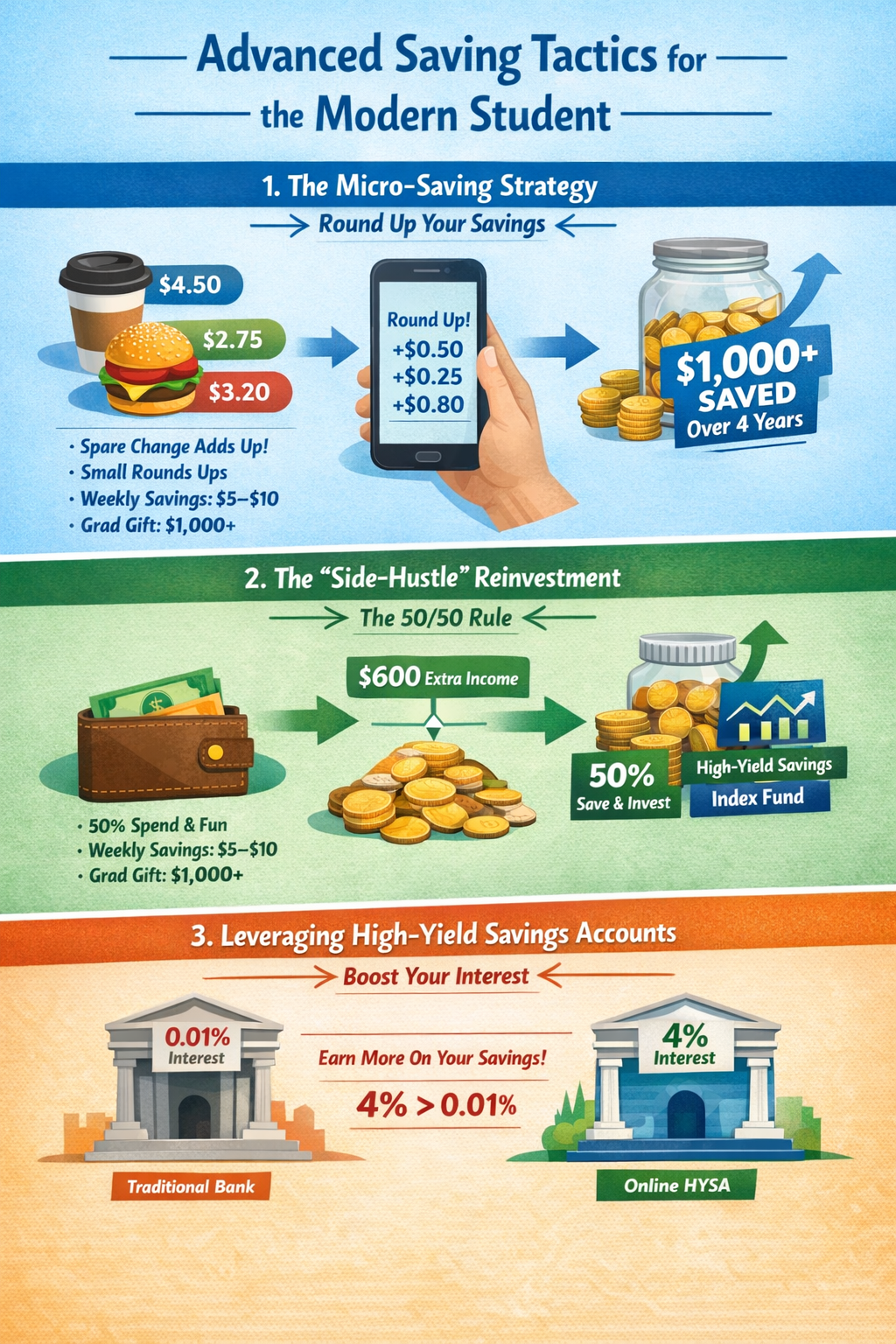
1. The Micro-Saving Strategy
Don’t wait until you have a “real job” to save. Use the “Rounding Up” method. Many modern banking apps (and third-party apps like Acorns) allow you to round up every purchase to the nearest dollar and put the change into a separate account. If you spend $4.50 on a coffee, $0.50 goes to savings. It feels invisible, but over a four-year degree, this can result in a significant “graduation gift” to yourself.
2. The “Side-Hustle” Reinvestment
If you have a part-time job or a freelance gig, try the 50/50 Rule. Take 50% of your earnings for your current living expenses and fun, and put the other 50% directly into a high-yield savings account or a low-cost index fund. Since you are likely already living on a “student budget,” you won’t miss the extra money, and it will give you a massive head start over your peers.
3. Leveraging High-Yield Savings Accounts (HYSA)
Most traditional banks offer savings accounts with interest rates close to 0%. However, online banks often offer High-Yield Savings Accounts with significantly higher rates. While it won’t make you a millionaire overnight, earning 4% on your emergency fund is better than earning 0.01%.
Frequently Asked Questions (FAQ)
Q1: Should I pay off my student loans while I’m still in school?
If your loans are unsubsidized, interest is accruing while you are in class. Paying even $20 or $50 a month toward the interest can prevent the “capitalization” of that interest (where the interest is added to the principal balance), saving you thousands in the long run. However, if your loans are subsidized, the government pays the interest while you’re in school, so you are better off putting that extra money into a savings account to earn interest for yourself.
Q2: Is it better to have an emergency fund or to be debt-free?
Always prioritize a small emergency fund first (usually $1,000 for a student). Being debt-free is a great goal, but if you have no cash and an emergency hits, you’ll just end up in more debt. Once the emergency fund is set, then focus on high-interest debt (like credit cards), and finally, long-term student loans.
Q3: How do I save money when my income is zero?
If you are living entirely on loans, “saving” means reducing your future debt. Every dollar you don’t spend is a dollar you don’t have to pay back with interest later. Focus on reducing expenses to minimize the amount of the loan you actually have to accept.
Q4: Should I get a credit card to “build credit”?
Yes, but only if you are disciplined. A credit card is a powerful tool for building the credit score you’ll need to buy a house or car later. However, you should treat it like a debit card: only spend what you already have in the bank and pay it off in full every single month. Never carry a balance.
Q5: What is the biggest mistake students make with money?
“Lifestyle Creep.” This happens when you get a small raise at work or a larger-than-expected loan refund and immediately increase your spending. If you can maintain a “Spartan” student lifestyle even as your income grows, you will be able to save at an incredible rate.
Final Thoughts
Building wealth as a student isn’t about deprivation; it’s about strategy. It’s about recognizing that every dollar has a “job” to do—whether that’s paying for the education that will fuel your career or sitting in a savings account to protect you from the unexpected. If you can master the balance between saving for the short term and borrowing wisely for the long term, you won’t just graduate with a degree—you’ll graduate with a foundation for a lifetime of financial peace.