What Document Explains Your Rights and Responsibilities as a Federal Student Loan Borrower? (It’s the MPN)
College. A life-changing decision, no doubt about it. But then you spotted that tuition number, huh? Instantly, your stomach dropped: “How in the world am I ever going to afford *that*?” Don’t worry, friend. You’re genuinely not alone in that immediate panic. Most folks certainly aren’t sitting on a secret stash of tens of thousands, perfectly ready for a university sticker shock. So, yes, you guessed it—student loans. They become a real conversation, don’t they?
In this guide, we are going to talk about Federal Student Loans. These are different from the loans you get at a regular bank. We’ll cover the “Golden Document” you have to sign, why these loans are usually way better than private ones, and how to handle them without losing your mind.
What Exactly is a Federal Student Loan?
You’re deep in the zone, right? Building a colossal Lego castle. Only hiccup? Five thousand necessary bricks are utterly, completely missing. What a pain. So you turn to a friend, approach them with a little urgency. “Hey, mind if I borrow these particular pieces? Don’t worry, they’re coming straight back the minute my grand fortress stands complete, and you’ll even get a couple of extra bricks as a token, a sincere thank you for helping me out of this bind.”
A federal student loan is exactly like that, but with money. The “friend” is the United States government. They lend you the money to pay for your classes, your dorm room, and your books. In return, you promise to pay them back later, plus a little bit extra called interest.
The Golden Document: The Master Promissory Note (MPN)
Before the government hands over a single penny, they make you sign something very important. It’s called the Master Promissory Note, or MPN for short.
[SIDE CARD: THE MPN CHECKLIST] The MPN is more than just a signature. It explains:
- Your Rights: Like the right to a “grace period” after graduation.
- Your Responsibilities: Like the fact that you MUST pay even if you don’t finish school.
- The Interest Rate: Exactly how much “extra” you’ll owe.
- The Terms: How many years you have to pay it all back.
If you’re wondering what document explains your rights and responsibilities as a federal student loan borrower, this is it. It’s the “Rule Book” for your loan. If you don’t read it, you might miss out on ways to save money later!
Federal vs. Private Loans: Why the Government is a Better “Friend”
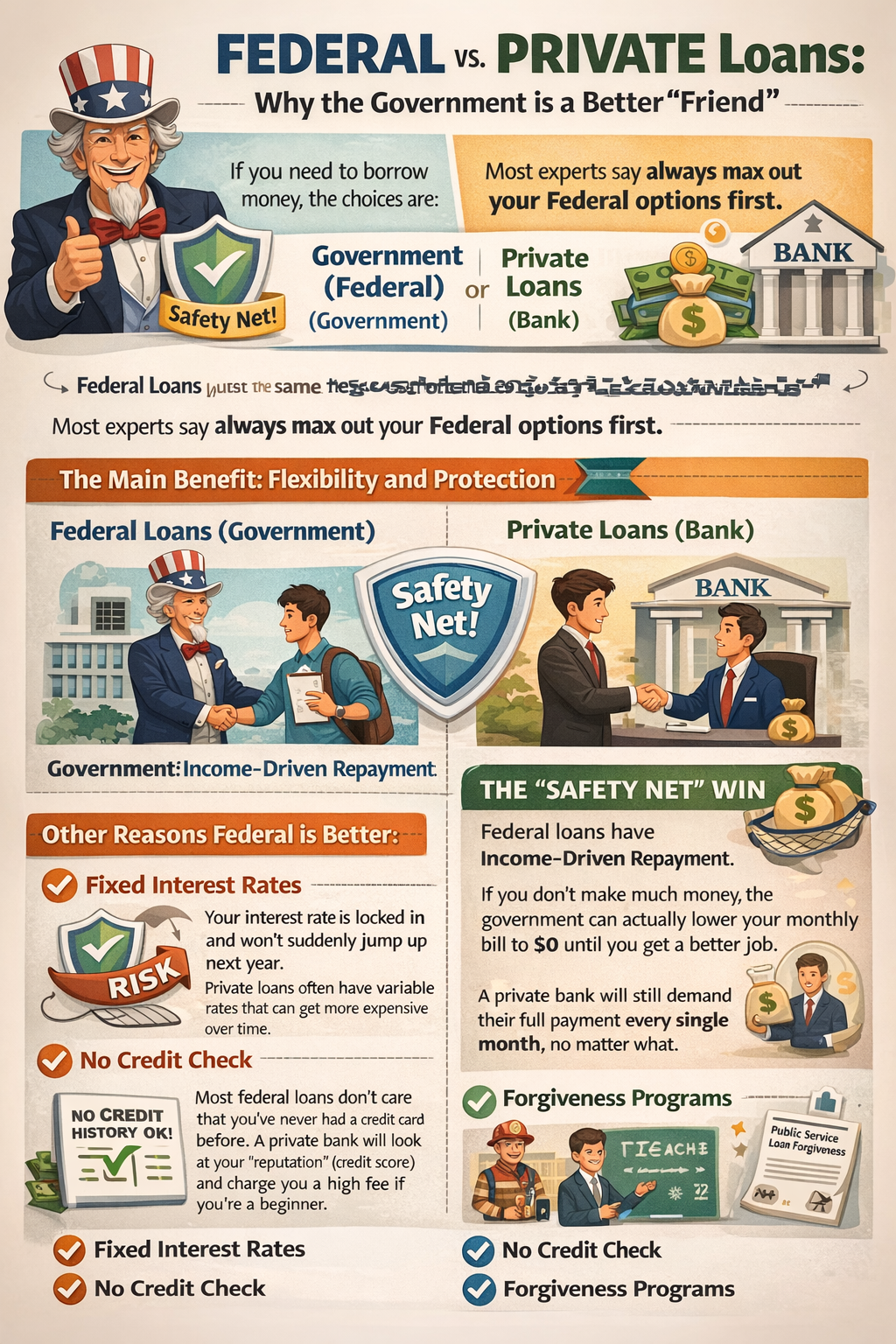
If you need to borrow money, you have two choices: the Government (Federal) or a Bank (Private). Most experts say you should always max out your Federal options first. Why? Because the government offers a Safety Net that a private bank just won’t give you.
The Main Benefit: Flexibility and Protection
The biggest reason to choose a federal loan is protection. Life happens. Sometimes you graduate and it takes six months to find a job. Sometimes you get a job, but it doesn’t pay as much as you hoped.
[SIDE CARD: THE “SAFETY NET” WIN] Federal loans have “Income-Driven Repayment.” If you don’t make much money, the government can actually lower your monthly bill to $0 until you get a better job. A private bank will still demand their full payment every single month, no matter what.
Other Reasons Federal is Better:
- Fixed Interest Rates: With a federal loan, your interest rate is locked in. It won’t suddenly jump up next year. Private loans often have “variable” rates that can get more expensive over time.
- No Credit Check: Most federal loans for students don’t care if you’ve never had a credit card before. They want to help you learn. A private bank will look at your “reputation” (credit score) and might say “No” or charge you a huge fee if you’re a beginner.
- Forgiveness Programs: Did you know that if you become a teacher or a firefighter, the government might eventually say, “Hey, thanks for helping the community, you don’t have to pay back the rest of your loan”? This is called Public Service Loan Forgiveness. Banks don’t do that!
Pro-Tips for Federal vs. Private Debt
- Federal Strategy: Never attempt debt settlement on federal loans unless you are in a “Total and Permanent Disability” (TPD) situation. Federal loans have “superpowers” (wage garnishment without a court order) that make settlement nearly impossible.
- Private Strategy: Treat private student loans like credit card debt. They are governed by the Statute of Limitations and are much more likely to settle for 40-60% once they reach the collections phase.
How Much Should You Borrow? (The “Easy” Rule)
Borrowing money feels like “free money” at first, but it isn’t. Every dollar you take today is a dollar (plus interest) that you have to take out of your future paycheck.
[SIDE CARD: THE >10,000 RULE] If you borrow more than $10,000, that might seem like a lot, but over 10 years, it’s about $110 a month. But if you borrow $50,000, you’re looking at over $500 a month! That’s a car payment! Always check your “Total Debt” before you sign for another year.
The “One Day” Test
Think about your future job. If you want to be a social worker, you might make $45,000 a year. If you want to be a doctor, you might make $200,000. ‘
The Rule: Try not to borrow more in total than you expect to make in your first year of work. If you expect to make $50k, don’t borrow $100k. That’s a recipe for a financial headache.
Managing Your Loan Like a Pro
Once you sign that MPN and start school, the clock starts ticking. But you don’t have to start paying right away.
The Grace Period
Most federal loans give you 6 months after you graduate before you have to send your first check. This is your time to find a job, get an apartment, and get settled.
Subsidized vs. Unsubsidized
This is a big word, but it’s easy to understand:
- Subsidized: The government pays the interest while you’re in school. (The “Premium” Loan).
- Unsubsidized: The interest starts growing the second you take the money. (The “Standard” Loan).
[SIDE CARD: THE “INTEREST” SNOWBALL] On an unsubsidized loan, if you don’t pay the interest while you’re in school, it gets added to your total. By the time you graduate, your $5,000 loan might have grown to $6,000 without you even spending an extra dime!
What Happens if You Can’t Pay?
This is where people get scared, but because you have a Federal loan, you have options.
- Deferment: You can pause your payments if you go back to school or if you’re in the military.
- Forbearance: You can pause payments for a short time if you have a medical emergency or a big bill you weren’t expecting.
- Consolidation: If you have 5 different loans, you can combine them into one easy payment.
The Golden Rule: Never, ever ignore the loan company. If you can’t pay, call them. They want to help you find a plan. If you just stop paying, they will ruin your credit score, and that makes life very hard later on.
Understanding Your Master Promissory Note (MPN)
The MPN is the legally binding document you sign when taking out federal student loans. It isn’t just a signature; it’s a contract that dictates your rights and responsibilities for the life of the loan.
The MPN Checklist: Rights vs. Responsibilities
| Your Rights (What you are entitled to) | Your Responsibilities (What you must do) |
| Grace Period: Usually 6 months after leaving school before payments start. | Repayment: You must pay regardless of whether you graduate or find a job. |
| Deferment/Forbearance: The right to pause payments during specific hardships. | Contact Info: You must notify your servicer of any name, address, or school changes. |
| Prepayment: The right to pay more than the minimum without penalty. | Exit Counseling: You are required to complete counseling upon leaving school. |
| Loan Cancellation: Specific rights to discharge in cases of total disability or school closure. | Agreement Terms: You must abide by the specific interest rates and fees listed. |
How to Access Your MPN
If you are considering debt settlement or consolidation, you need to see the original terms you agreed to.
- Download: Keep a PDF copy for your records; your loan servicer’s version may sometimes differ in formatting.
- Log In: Go to StudentAid.gov using your FSA ID.
- Navigate: Go to “My Documents.”
- Filter: Select “Master Promissory Note” from the document type dropdown.
Frequently Asked Questions
What document explains my rights as a borrower?
The Master Promissory Note (MPN) is the legal document that explains your rights, responsibilities, loan terms, interest rates, repayment options, and borrower obligations for federal student loans.
Is it easy to get a federal loan?
Yes. For most students, as long as you fill out the FAFSA (the big financial aid form), you will be offered federal loans regardless of your income or credit.
Why shouldn’t I just go to a private bank?
Private banks are in the business of making a profit. The government is in the business of helping you get an education. Private loans don’t have the same “Safety Nets” like income-driven repayment or loan forgiveness.
Final Thoughts: Be the Boss of Your Debt
Loans aren’t “bad.” They are a tool. Like a hammer, they can help you build something great (your career), or they can hurt you if you aren’t careful. By signing your MPN, knowing your rights, and choosing Federal over Private, you are already ahead of most students.
Stay smart, borrow only what you need, and keep your eye on the prize: that graduation stage!