
Personal Finance for College Students: Guide to Managing Money, Credit, and Debt
College is a unique financial window. For most students, it is the first time they manage a significant sum of money—whether from financial aid, scholarships, or a part-time job—without a direct safety net. However, the financial habits formed during these four years often dictate the trajectory of your adult life. A single mistake, such as an ignored $35 overdraft fee or a maxed-out “student” credit card, can follow you long after graduation.
This guide is designed to provide you with a tactical roadmap to build wealth, protect your credit score, and graduate with a foundation for lifelong financial success. By the time you finish this guide, you will understand the mechanics of banking, the psychology of spending, and the technical breakdown of the credit scoring system that governs your future purchasing power.
Opening and Managing a Student Checking Account
A student checking account is your financial “home base.” It is the hub where your income lands and your expenses depart. Unlike a savings account, which is a reservoir for long-term accumulation, a checking account is a pipeline designed for high-frequency transactions.
What Is a Student Checking Account?
Standard bank accounts often come with monthly maintenance fees (averaging $12–$15) unless you maintain a high balance. Student Checking Accounts waive these fees to attract young customers. These accounts are designed to handle the frequent, smaller transactions typical of a student lifestyle, often including robust mobile apps and digital wallet integrations.
[SIDE CARD: THE “FREE” TRAP] Banks offer “free” accounts to students because they know you’re unlikely to switch banks later. Always check the fine print: Does “free” expire at age 24 or upon graduation? If you don’t switch before the deadline, you could be hit with monthly fees without notice. Set a calendar reminder for your graduation month to review your account status.
Why Every College Student Needs a Checking Account
- Tracking Income and Expenses: Digital statements provide a clear history of where your money goes. In a world of contactless payments, it is easy to lose track of “micro-transactions” (like $4 coffees) that add up to hundreds of dollars a month.
- Building a Relationship: Establishing a history with a bank makes it easier to get approved for car loans or mortgages later. Lenders prefer to see a stable, long-term relationship with a primary financial institution.
- Early Credit Steps: Some banks offer “credit builder” tools or small lines of credit linked directly to your checking account, which can serve as a training wheels version of a credit card.
Understanding Banking Fees and How to Avoid Them
Lenders and banks profit significantly from student errors. To keep your money, you must master the vocabulary of fees:
- Non-Sufficient Funds (NSF) Fees: This occurs when you write a check or authorize a payment for more money than you have. The bank rejects the payment and charges you a fee—often $35. This is double-jeopardy: your bill remains unpaid (accruing late fees from the merchant), and the bank charges you for the failure.
- Overdraft Fees: This is the “polite” version of an NSF. Instead of rejecting the payment, the bank pays it for you, essentially giving you a forced loan. However, they will charge you a fee (also ~$35) for every transaction that puts you in the negative. If you buy a $2 pack of gum while overdrawn, that gum just cost you $37.
- ATM Fees: Using an “out-of-network” machine results in a “Double Dip.” The machine owner charges you a fee, and your bank charges you another. It can cost $5.50 just to access $20 of your own cash.
Tactical Tip: Opt-out of “Overdraft Protection” for point-of-sale transactions. While it sounds scary, it simply means your card will be declined at the register if you don’t have the funds, saving you from a $35 fee.
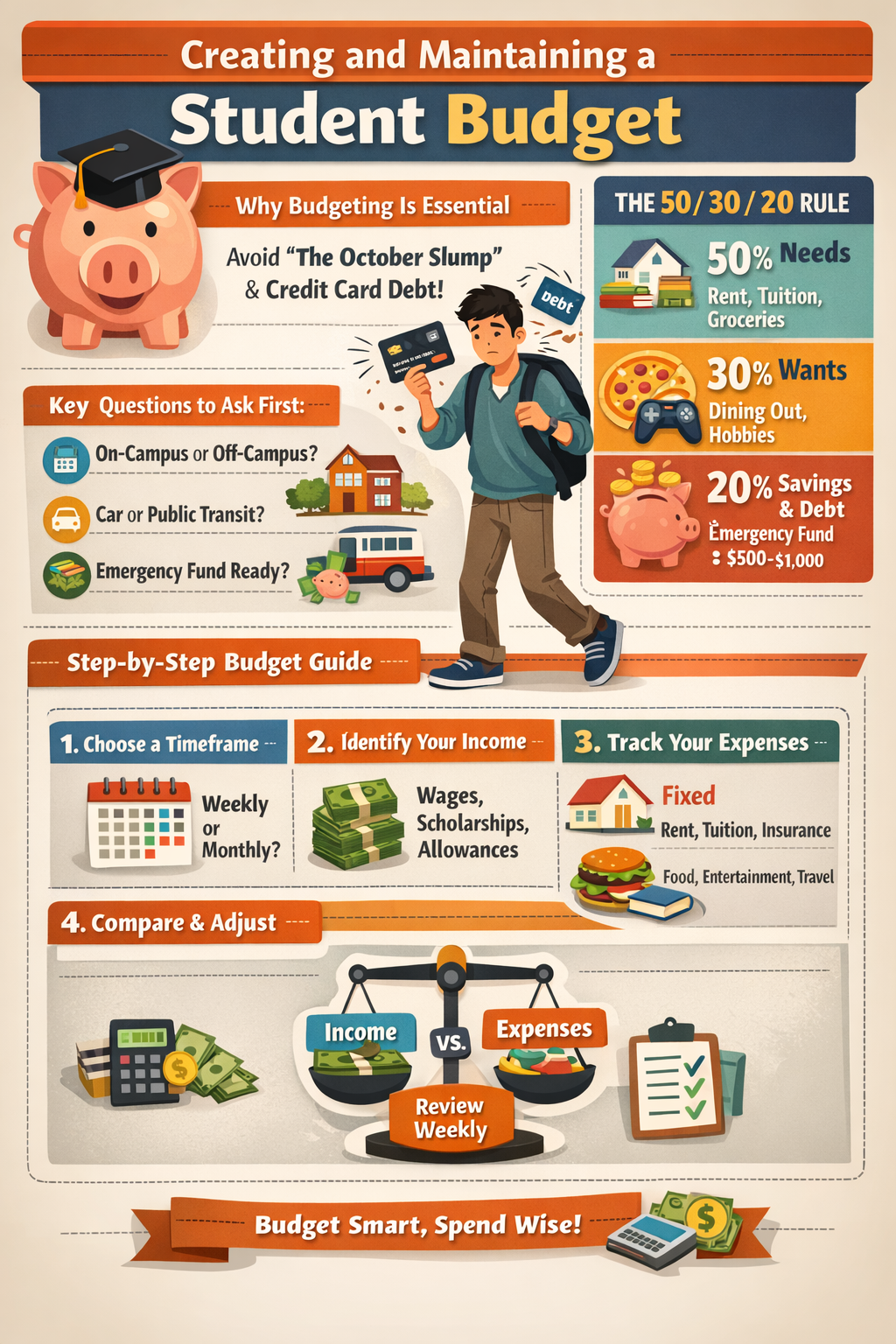
Creating and Maintaining a Student Budget
Budgeting isn’t about restriction; it’s about clarity. It is the act of giving every dollar a “job” before it leaves your hand. For students, the biggest challenge is managing irregular income—scholarships that arrive once a semester or varying shifts at a campus job.
Why Budgeting Is Essential
Without a plan, students often experience “The October Slump.” This is when the lump-sum financial aid received in September begins to run dry, leading to high-interest credit card usage to survive until the next disbursement. Budgeting allows you to smooth out these peaks and valleys.
[SIDE CARD: THE 50/30/20 RULE] A classic budgeting framework adapted for students:
- 50% for Needs (Rent, Tuition, Basic Groceries, Insurance)
- 30% for Wants (Dining out, Concerts, Hobbies, Subscriptions)
- 20% for Savings/Debt (Emergency fund, paying off credit cards, or early student loan payments)
Key Questions Before Creating a Budget
Before putting pen to paper (or finger to app), audit your lifestyle. Do you live on-campus (fixed meal plan) or off-campus (variable grocery costs)? Do you have a car (insurance, gas, maintenance) or use public transit? Do you have an emergency fund? A student’s emergency fund should be at least $500–$1,000 to cover a broken laptop or an unexpected flight home.
The Step-by-Step Student Budget Guide
- Choose a Timeframe: Weekly budgeting is often best for students because it allows for quick adjustments based on social activities. A month is too long to wait to realize you spent your entire “fun” budget in the first week.
- Identify All Income: Include wages, allowances, scholarships, financial aid refunds, and even birthday gifts.
- Categorize Expenses: * Fixed: Rent, insurance, phone bill, tuition.
- Variable: Food, entertainment, travel, textbooks.
- Compare Income vs. Expenses: If expenses exceed income, you are living on debt. This is unsustainable. You must cut variable spending—the “wants”—until the math balances.
- Review and Adjust: Re-evaluate your budget every Sunday evening to prepare for the week ahead. Life changes, and your budget should be a “living” document.
Building Credit as a College Student
Credit is your financial “GPA.” Just as a low GPA can limit your career options, a low credit score can prevent you from renting an apartment, getting a phone plan without a massive deposit, or securing low interest rates on future loans.
What Is Credit and Why It Matters
Credit is a measure of trust. Your Credit History is a record of how you have handled borrowed money in the past. Your Credit Score is the numerical shorthand for that history. A high score tells the world you are a responsible adult; a low score suggests you are a risk.
Simple Ways to Build Credit
- Student Checking and Savings: While these don’t directly report to credit bureaus, a long history with a bank helps when you apply for their specific credit products later.
- Student Credit Cards: These have lower limits ($300–$1,000) and are easier to qualify for. The rule: Only spend what you can pay off in full every month. Never carry a balance to “build credit”—that is a myth that only costs you interest.
- Secured Credit Cards: You provide a deposit (e.g., $200), and the bank gives you a $200 credit limit. Since the bank holds your money as collateral, they are willing to take a chance on you. After a year of on-time payments, most banks will “graduate” you to an unsecured card and return your deposit.
- Co-signed Loans: A parent or guardian adds their credit history to yours. This is a massive responsibility; if you miss a payment, you damage the credit score of the person who trusted you.
How to Choose the Right Student Credit Card
Look for No Annual Fee and Cash Back on things you already buy, like gas or groceries. Avoid “Introductory 0% APR” offers unless you have a strict, disciplined plan to pay a large purchase off before the interest kicks in (usually at 25% or higher). Always read the “Schumer Box”—the standardized table that lists all interest rates and fees.
Avoiding Debt and Protecting Your Credit Score
The average undergraduate leaves college with over $3,000 in credit card debt. This isn’t usually from one large purchase, but from hundreds of small ones—lattes, late-night pizzas, and rideshares—that were never paid off, allowing interest to snowball.
Why Paying Only the Minimum Is Costly
Credit card interest is compounded, meaning you pay interest on your interest. If you only pay the minimum, you are mostly paying off the finance charges, and the principal balance barely budges.
The Math of Debt: If you owe $1,000 at 22% APR and only pay the minimum (usually around $25), it could take you over 10 years to pay it off and cost you more than $2,100 total. You would be paying for those college pizzas well into your 30s.
Smart Credit Card Repayment Strategies
- Pay in Full: This is the gold standard. It results in $0 interest charges.
- Fixed Monthly Payments: If you can’t pay in full, pick a high fixed amount (e.g., $100) and stick to it rather than following the declining “minimum” suggested by the bank.
- The Snowball Method: If you have multiple debts, pay the minimum on all but the smallest one. Attack the smallest with everything you have until it’s gone, then move to the next.
Factors That Affect Your Credit Score
- Payment History (35%): The most critical factor. One payment missed by 30 days can tank a high score by 100 points and stays on your report for seven years.
- Amounts Owed (30%): Also known as Credit Utilization. This is the ratio of your balance to your limit.
[SIDE CARD: THE 30% UTILIZATION RULE] Using more than 30% of your credit limit (e.g., spending $150 on a $500 card) can lower your credit score, even if you pay it off. Lenders view high utilization as a sign of financial stress. For the best score, aim for 1-10% utilization.
- Length of Credit History (15%): Older accounts are better. This is why you should never close your first credit card, even if you don’t use it often.
- Credit Mix (10%): Having a variety of credit (a card, a student loan, a car loan) shows you can handle different repayment structures.
- New Credit (10%): Every time you apply for credit, a “Hard Inquiry” occurs, which drops your score slightly. Opening multiple accounts in a short window makes you look desperate to lenders.
Reviewing Your Credit Report
Identity theft is a major risk for students. Visit AnnualCreditReport.com to get your free legal report from the three major bureaus (Equifax, Experian, and TransUnion). This is the only site authorized by federal law. Check for accounts you didn’t open or late payments you didn’t actually miss.
Frequently Asked Questions
Q: What happens if I overdraft my checking account?
The bank will charge you a fee (avg. $35). If you don’t pay it back within a few days, they may close your account and report you to ChexSystems. This is like a credit bureau for banks; once you’re on that list, it is nearly impossible to open a bank account anywhere for up to five years.
Q: How can I avoid ATM and overdraft fees?
Use your bank’s app to find in-network ATMs. Opt-out of overdraft protection. Set up “Push Notifications” for every transaction so you always know your exact balance.
Q: How early should I start building credit?
As soon as you turn 18. Because 15% of your score is based on the “age” of your accounts, starting early gives you a massive advantage when you graduate and need to buy a car or rent an apartment.
Q: What’s the safest way to use a credit card in college?
Put one small, recurring subscription (like Spotify or Netflix) on the card, set it to “Auto-Pay In Full” from your checking account, and then hide the card in a drawer. You will build a perfect credit history automatically without the temptation to overspend.
Final Thoughts: Building Financial Confidence
Small financial decisions add up. Taking control of your money in college isn’t about being wealthy right now; it’s about developing the habits that will make you wealthy in the future. Managing your money is a skill, like learning a language or a sport—it requires practice, discipline, and the right information. Graduate with more than just a degree—graduate with a financial foundation that gives you the freedom to pursue your dreams without the weight of debt.