Best Budgeting Tools in 2026: Goal-Based, Family, and Business Solutions
The financial landscape of 2026 has moved far beyond the simple spreadsheet. As we navigate a global economy defined by high-interest rates, fluctuating inflation, and the “subscription-infixation” of every service, the tools we use to manage our money must be more sophisticated than ever.
Today, budgeting is no longer just about tracking what you spent; it is about predictive analysis, automated wealth building, and collaborative financial planning. Whether you are a solo entrepreneur, a head of a household, or a fintech enthusiast, finding the right platform is the first step toward financial freedom.
1. The Paradigm Shift: Why 2026 Budgeting is Different
In previous years, budgeting was a reactive process—looking at a bank statement at the end of the month and feeling regret. In 2026, the best tools are proactive. They utilize Open Banking APIs to provide real-time updates and AI-driven insights that forecast your bank balance 30 days into the future.
We are seeing a move toward Goal-Based Budgeting. This methodology prioritizes “the why” over “the what.” Instead of just seeing a $500 grocery bill, 2026 tools help you understand how that spending affects your ability to buy a home in three years or retire by fifty.
2. Best Goal-Based Budgeting Tools
Goal-based tools are designed for people who find traditional categories (like “Utilities” or “Dining Out”) boring. These tools focus on outcomes.
YNAB (You Need A Budget)
While an older player, YNAB remains the gold standard in 2026 for one reason: The Zero-Based Budgeting Method.
- The Philosophy: Every dollar is given a “job” before it is spent.
- 2065 Updates: Improved “Loan Planner” tools that calculate exactly how much time and interest you save by making extra payments toward your mortgage or student loans.
- Best For: Those who want total control and are willing to endure a slight learning curve to break the paycheck-to-paycheck cycle.
Monarch Money
Monarch has surged in popularity as the primary alternative for former Mint users.
- Key Feature: The “Plan” view. It allows you to visualize your net worth trajectory alongside your monthly budget.
- AI Integration: Monarch’s 2026 update includes an AI assistant that identifies “ghost subscriptions”—recurring charges for services you haven’t used in over 90 days.
- Best For: Long-term wealth builders who want a premium, ad-free experience.
3. Best Family and Collaborative Budgeting Solutions
Managing money as a couple or a family introduces complexity: joint accounts, individual “fun money,” and shared household expenses.
Zeta: Joint Cards & Tools
Zeta has matured into the leading solution for modern couples. It offers “Joint Cards” that act like a digital envelope system for two people.
- Collaborative Logic: It allows for “yours, mine, and ours” views, meaning you can maintain financial privacy while being fully transparent about shared goals.
- The “Memos” Feature: Couples can leave comments on specific transactions, reducing the “What was this $40 at Amazon for?” arguments.
PocketGuard
For families with a high volume of transactions, PocketGuard’s “In My Pocket” feature is a lifesaver. It calculates how much spendable income is left after accounting for bills, goals, and current spending.
- Family Safety: It includes robust alerts for when a family member exceeds a specific category limit, such as “Entertainment” or “Dining.”
4. Fintech-First: The Best Neobank Budgeting Features
If you don’t want a standalone app, many neobanks (Fintech banks) have integrated budgeting tools that rival paid software.
Revolut (Ultra & Premium)
Revolut has turned its banking app into a financial super-app. In 2026, its budgeting suite includes:
- Smart Pockets: Automatically set aside money for bills the moment your salary hits the account.
- Commodity Tracking: For fintech users who budget in a mix of fiat and crypto, Revolut provides a unified view of purchasing power.
SoFi
SoFi’s “Relay” feature provides a holistic view of your financial life, including credit score monitoring and investment tracking.
- Automation: You can set up “Autopilot” to move money into high-yield “Vaults” based on your monthly budget surplus.
5. Best Business Budgeting Solutions (Small Business & Freelance)
Freelancers and small business owners face the unique challenge of “Variable Income.” A static budget doesn’t work when one month is $2,000 and the next is $10,000.
QuickBooks Solopreneur
Specifically designed for the “one-person business,” this tool bridges the gap between personal finance and tax-ready business accounting.
- Automatic Tax Projections: It calculates your estimated quarterly tax payments in real-time as you log income.
- Receipt Capture: Uses OCR technology to categorize business expenses directly into your budget.
Ramp (For Scaling Businesses)
For businesses with employees, Ramp offers more than just budgeting; it offers Spend Management.
- Corporate Cards with Limits: You can issue a card to an employee with a hard budget of $200/month for “Software.” The card will decline if they try to spend $201.
- Real-time Visibility: Managers see every dollar spent across the company instantly, eliminating the need for end-of-month expense reports.
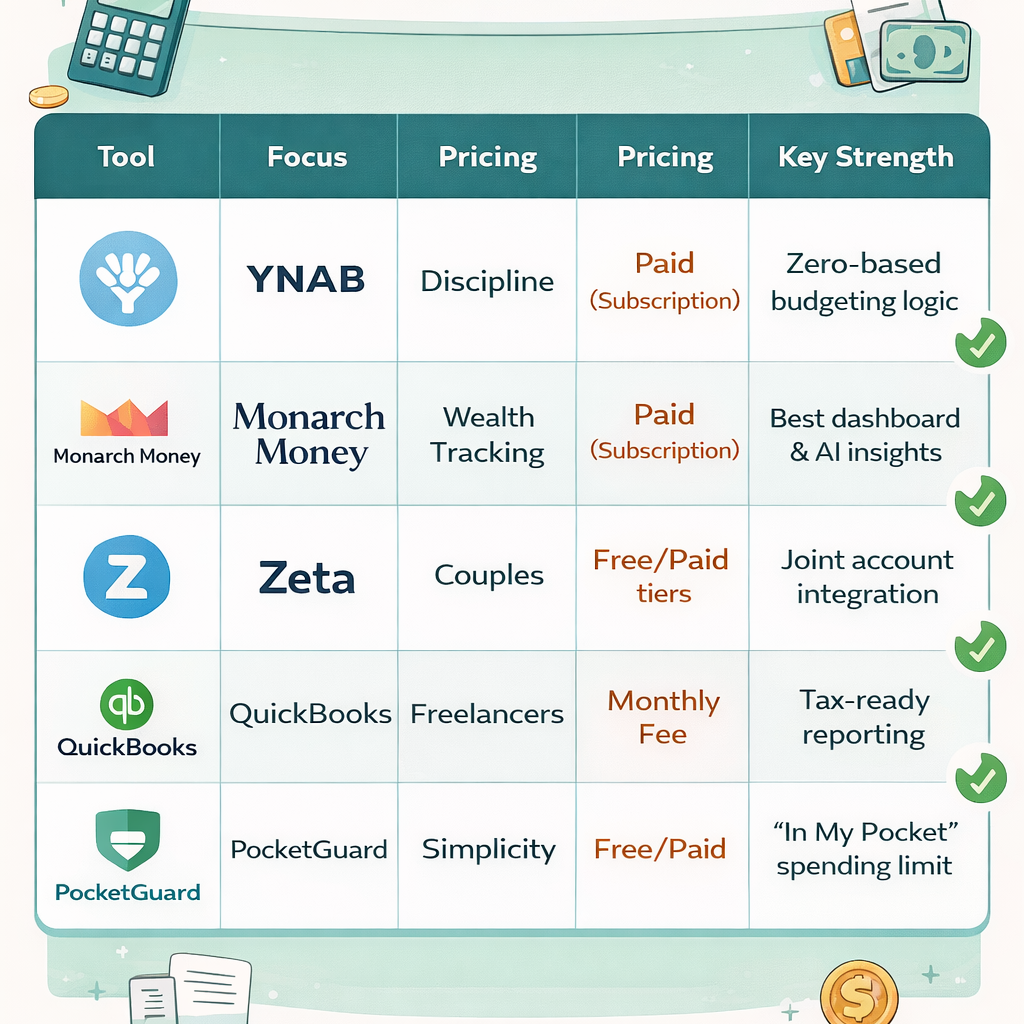
6. Comparison Table: At a Glance
| Tool | Focus | Pricing | Key Strength |
|---|---|---|---|
| YNAB | Discipline | Paid (Subscription) | Zero-based budgeting logic |
| Monarch Money | Wealth Tracking | Paid (Subscription) | Best dashboard & AI insights |
| Zeta | Couples | Free/Paid tiers | Joint account integration |
| QuickBooks | Freelancers | Monthly Fee | Tax-ready reporting |
| PocketGuard | Simplicity | Free/Paid | “In My Pocket” spending limit |
7. How to Choose the Right Tool for Your Lifestyle
Selecting a tool depends on your Financial Personality Type:
- The Architect (Goal-Oriented): You want to see how today’s coffee affects your retirement. Choose: Monarch Money.
- The Micro-Manager (Control-Oriented): You want to account for every cent. Choose: YNAB.
- The Minimalist (Time-Oriented): You want the app to do the work. Choose: PocketGuard or SoFi Relay.
- The Team Player (Collaborative): You are managing a household. Choose: Zeta.
8. The Future of Budgeting: Trends to Watch in late 2026
As we move toward 2026, keep an eye on these emerging features:
- Predictive AI Spending: Tools will soon warn you: “Based on your current trend, you will overspend on groceries by $150 by the 25th of the month.”
- Carbon Footprint Tracking: Some fintech tools are now calculating the environmental impact of your spending alongside the financial cost.
- Embedded Finance: More retailers will offer “Budget-Check” at checkout, telling you if a purchase fits your predefined monthly allowance before you swipe.
9. Frequently Asked Questions (FAQs)
Is it safe to link my bank account to these apps?
In 2025, most reputable apps use read-only connections via services like Plaid or Salt Edge. They do not store your bank login credentials and cannot move your money without your explicit authorization. Always look for 256-bit encryption and Multi-Factor Authentication (MFA).
Why should I pay for a budgeting app when Excel is free?
While Excel is powerful, it requires manual entry. Modern apps automate the data gathering, categorize expenses using machine learning, and provide mobile access that allows you to check your “Spendable” balance while you are actually in a store. The time saved is usually worth the $8–$15 monthly fee.
Can I use these tools for debt payoff?
Yes. Many of these tools (especially YNAB and Monarch) have specific modules for the Debt Snowball or Debt Avalanche methods. They help you visualize how extra payments reduce your interest over time.
What is the best app for variable income?
YNAB is widely considered the best for variable income because it only allows you to budget “the money you have right now.” When a big check comes in, you assign those dollars; when income is low, you only fill your most immediate “envelopes.”
Do these apps help with taxes?
Business-focused apps like QuickBooks and Ramp are built for tax compliance. Personal apps like Monarch allow you to tag transactions as “Tax Deductible,” making it much easier to export a report for your accountant at the end of the year.
Can budgeting tools track my investments?
Monarch Money, SoFi, and Empower (formerly Personal Capital) are excellent at tracking 401ks, IRAs, and brokerage accounts alongside your daily spending. YNAB is less focused on investments and more on cash flow.
10. Conclusion: Taking the First Step
The “best” budgeting tool is not the one with the most features; it is the one you will actually use. If an app feels like a chore, you will eventually abandon it.
For 2026, the recommendation for most people is to start with a 30-day trial of Monarch Money for a high-level view or YNAB if you feel your spending is currently out of control. Remember, a budget isn’t a restriction on your freedom—it’s a roadmap to the life you want to lead.