Why Your Budget isn’t Working ? 7 Common Mistakes & Solutions
It is a familiar cycle: you spend hours meticulously categorizing expenses, setting limits, and building spreadsheets, only to find that by the middle of the month, the plan has fallen apart. If your budget feels more like a source of stress than a tool for freedom, you aren’t alone.
Most budgets fail not because of a lack of willpower, but because of structural flaws in the plan itself. Here are the seven most common reasons your budget isn’t working—and the strategic shifts you can make to fix them.
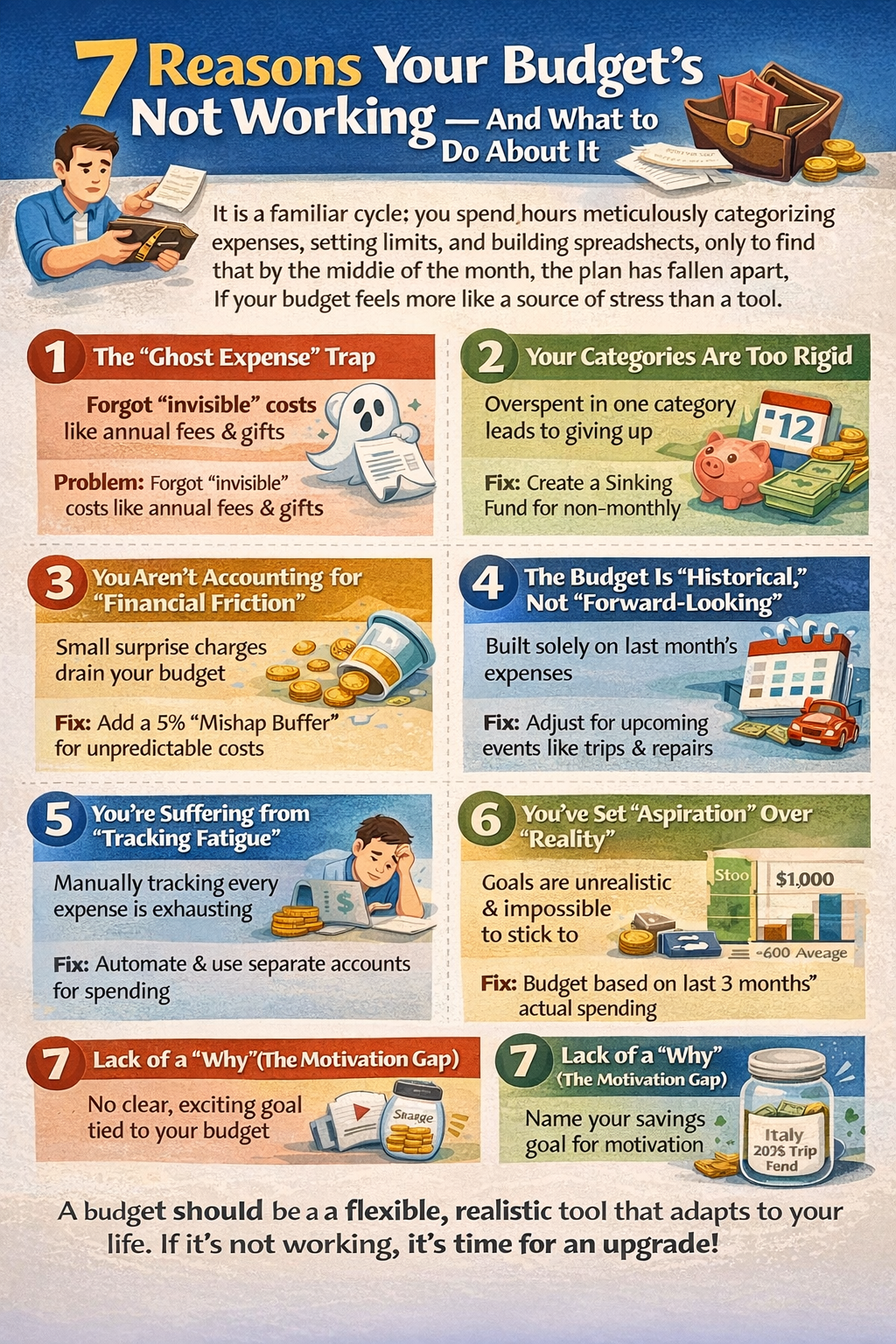
1. The “Ghost Expense” Trap
The Problem: You accounted for rent, groceries, and insurance, but forgot the “invisible” costs. These are the quarterly car registrations, the annual apps subscriptions, or the gift for a friend’s birthday. Individually, they are small; collectively, they are budget killers.
The Fix: Transition to a “Sinking Fund” model. Total up all your annual non-monthly expenses, divide by 12, and treat that amount as a monthly “bill” that goes into a dedicated savings account. When the registration or holiday season arrives, the money is already there.
2. Your Categories Are Too Rigid
The Problem: You budgeted exactly $100 for “Entertainment” and $400 for “Groceries.” If you spend $110 on a concert ticket, you feel like you’ve “failed,” leading to a “what the heck” effect where you abandon the budget entirely for the rest of the month.
The Fix: Use the 60/20/20 Rule or Category Bucketing. Group your spending into broader categories (Needs, Wants, Savings). If you overspend on a dinner out, simply pull that money from your “Wants” bucket elsewhere. Flexibility prevents total abandonment.
3. You Aren’t Accounting for “Financial Friction”
The Problem: Your budget looks perfect on paper because it assumes you are a robot. It doesn’t account for the $5 convenience fee, the surge pricing on a ride-share when it rains, or the extra $10 spent because you forgot to pack a lunch.
The Fix: Build a 5% “Mishap Buffer” into your budget. This isn’t an emergency fund; it’s a “life happens” fund. By explicitly budgeting for small, unpredictable leaks, you stop those leaks from draining your main categories.
4. The Budget Is “Historical,” Not “Forward-Looking”
The Problem: Many people build budgets based solely on what they spent last month. However, next month is never an exact replica of the last. A budget based on the past is a post-mortem, not a plan.
The Fix: Perform a Calendar Review before the month starts. Look at your schedule. Do you have a wedding? A long weekend? A car service? Adjust your numbers before the month begins based on what is actually on your horizon.
5. You’re Suffering from “Tracking Fatigue”
The Problem: If your budget requires you to manually input every single pack of gum or coffee into an app, you will eventually stop doing it. Manual tracking is the most common point of failure for busy professionals.
The Fix: Automate and Segregate. Set up automatic transfers for savings and fixed bills the moment your paycheck hits. For “discretionary” spending, use a separate bank account or a specific debit card. When that card hits zero, your spending for the month is done—no manual tracking required.
6. You’ve Set “Aspiration” Over “Reality”
The Problem: You want to save $1,000 a month, so you set your grocery budget to $200, despite the fact that you haven’t spent less than $600 in years. Setting a budget based on who you wish you were, rather than who you are, leads to immediate failure.
The Fix: Use the “Last 3 Months” Average. Look at your actual bank statements. If you spent $600 on food, set your budget at $550. Aim for a 5-10% improvement rather than a 50% overhaul. Sustainable progress beats radical, temporary change.
7. Lack of a “Why” (The Motivation Gap)
The Problem: Budgeting feels like a restriction. Without a clear, exciting goal attached to the numbers, the psychological cost of saying “no” to a purchase eventually outweighs the perceived benefit of the budget.
The Fix: Name Your Savings. Instead of a generic “Savings” category, name it “Italy 2026 Trip” or “Debt-Free by December.” When you look at your budget, you aren’t seeing what you can’t buy; you’re seeing the progress you’re making toward something you love.
Conclusion
A budget is not a ceiling that keeps you down; it is a ladder that helps you climb. If your current system isn’t working, stop trying to change your behavior to fit the spreadsheet. Instead, change the spreadsheet to fit your life. By adding flexibility, automation, and realism, you transform your budget from a chore into a competitive advantage.
Frequently Asked Questions: Why Budgets Fail
1. How often should I realistically review my budget?
While you should track spending weekly to stay aware, a formal “Budget Reset” should happen once a month, about 3-5 days before the new month begins. This allows you to look ahead at your calendar for upcoming events (weddings, holidays, or annual dues) that require specific adjustments.
2. Is it better to use an app or a manual spreadsheet?
The best tool is the one you actually use.
- Apps (like YNAB or Monarch) are great for automation and real-time syncing.
- Spreadsheets offer total customization and force a deeper psychological connection with your numbers.
- The “Two-Account” Method: If both feel like too much work, simply send your “spending money” to a separate debit card and stop when the balance hits zero.
3. What is a “Sinking Fund” and how is it different from an Emergency Fund?
An Emergency Fund is for the “unknown unknowns”—unforeseen events like a job loss or a major medical emergency. A Sinking Fund is for “known unknowns”—expenses you know are coming but don’t happen every month, such as car tires, holiday gifts, or semi-annual insurance premiums.
4. My income is irregular (freelance/commission). How do I budget?
When income fluctuates, you should budget based on your “Floor Income” (the minimum you know you will make).
- Use your floor income to cover essential “Needs.”
- Create a “Priority List” for any income that comes in above that floor.
- During high-earning months, build a “Hill and Valley” fund to supplement your spending during low-earning months.
5. I keep overspending on groceries. How do I fix this specific category?
Groceries are the most common “variable” failure. To fix this:
- Shop your pantry first: See what you already have before going to the store.
- Use “Unit Pricing”: Compare the price per ounce/gram rather than the total package price.
- Try Grocery Pickup: Ordering online prevents “impulse adds” to the cart and keeps a running total of your bill before you checkout.
6. What should I do if I have a “bad month” and blow my budget?
Don’t wait until the 1st of next month to start over. Perform a “Mini-Reset.” Acknowledge the overspend, identify why it happened (Was it a lack of planning or an emotional purchase?), adjust your remaining categories to cover the gap if possible, and move on immediately. One bad week shouldn’t ruin a 52-week goal.
7. How much “Fun Money” should I allow myself?
A budget that is too restrictive will eventually lead to “frugal fatigue,” much like a crash diet leads to binge eating. Most experts recommend a “10% Play Rule.” Allocate 10% of your take-home pay to guilt-free spending. If you can’t afford 10%, even a small, set amount like $20 a week can provide the psychological “breathing room” needed to stay disciplined with your larger goals.