What Is a Thin Credit File? (How 62 Million Americans Can Fix Theirs)
A thin credit file means you have fewer than 5 active credit accounts, making it harder to get loans or good interest rates. Learn what causes thin files, how they affect your credit score, and the 7 proven strategies to thicken your credit profile fast—including rent reporting.
You apply for an apartment. The landlord pulls your credit. Minutes later, they’re asking for an extra security deposit—or worse, denying you outright.
The reason? Your credit file is ‘too thin.’
You’re not alone. According to Experian, approximately 62 million Americans have thin credit files as of 2024. That’s roughly one in five adults in the United States.
But here’s what most people don’t understand: having a thin credit file doesn’t mean you’re bad with money. It often just means the credit bureaus don’t have enough information about you yet.
| Quick Definition: A thin credit file is a credit report with fewer than 5 active credit accounts (credit cards, loans, lines of credit). Having a thin file makes it difficult to generate a credit score and can result in higher interest rates, loan denials, or additional deposit requirements when renting. About 62 million Americans currently have thin credit files. |
What You’ll Learn
- The exact definition of a thin credit file (and how it differs from being ‘credit invisible’)
- 62 million Americans affected: who’s most likely to have a thin file
- How thin files affect credit scores and loan approvals
- 7 proven strategies to thicken your credit file (ranked by effectiveness)
- Timeline: how long it takes to go from thin to thick credit
- Common mistakes that keep your file thin (even when you’re trying to fix it)
What Exactly Is a Thin Credit File?
A thin credit file is a credit report that contains very few active credit accounts—typically fewer than 5 tradelines.
What counts as a tradeline?
- Credit cards (secured or unsecured)
- Auto loans
- Mortgages
- Personal loans
- Student loans
- Credit builder loans
- Lines of credit
- Rent payments (when reported through services like AxcessRent)
What doesn’t count:
- Utility bills (unless specifically enrolled in reporting programs)
- Rent payments (unless reported through a service)
- Cell phone bills (unless enrolled)
- Debit card transactions
- Prepaid card usage
- Checking or savings accounts
The spectrum of credit visibility:
| Category | Definition | Americans Affected |
| Credit Invisible | No credit file at all with any major bureau | 26-28 million (11% of adults) |
| Thin Credit File | Has credit file but fewer than 5 accounts; may be unscorable | 62 million (26% of adults) |
| Thick Credit File | 5+ active accounts with established payment history | ~150 million (63% of adults) |
To understand how these files are even calculated, check out our Introduction to Credit Scores: A Comprehensive Guide.
Who’s Most Likely to Have a Thin Credit File?
According to data from the Consumer Financial Protection Bureau (CFPB) and TransUnion, certain demographics are significantly more likely to have thin credit files:
1. Young Adults (Ages 18-25)
Nearly 40% of young adults have thin credit files simply because they haven’t had time to build credit history.
Why: The CARD Act of 2009 made it harder for people under 21 to get credit cards without a co-signer or proof of income. While this protected young people from predatory lending, it also made credit building more difficult. Add in the rise of debit cards and prepaid cards (which don’t build credit), and you have a generation struggling to establish credit.
2. Recent Immigrants
Even if you had excellent credit in your home country, that history doesn’t transfer to U.S. credit bureaus. Starting over from zero means building a thin file from scratch.
3. People in Low-Income Areas
According to CFPB research, nearly 30% of consumers in low-income neighborhoods are credit invisible, and another 15% have unscorable thin files.
Why: Limited access to traditional banking, fewer opportunities for credit cards or loans, and reliance on cash or alternative financial services (check cashing, payday loans) all contribute.
4. Older Adults Who Paid Off Everything
If you paid off your mortgage, cars, and credit cards years ago and now live debt-free, your credit file may have thinned. Credit scoring models prioritize recent activity, so old paid-off accounts eventually fall off your report or become ‘stale.’
5. Cash-Preferring Consumers
Some people avoid credit on principle, paying for everything with cash or debit cards. While financially responsible, this approach leaves you credit invisible or with a very thin file.
6. Black and Hispanic Consumers (Disproportionately Affected)
CFPB research found that Black and Hispanic consumers are 15% more likely to be credit invisible compared to white consumers (15% vs. 9%).
This disparity reflects systemic inequalities in access to credit, banking services, and financial education.
How a Thin Credit File Affects Your Financial Life
Having a thin credit file creates tangible financial barriers:
1. Lower Credit Scores (or No Score at All)
Credit scoring models separate consumers into groups before assigning scores. If you’re in the ‘thin file’ group, you’ll typically score lower than someone with a thick file—even if you’ve never missed a payment.
Even worse: If you have fewer than 1-2 active accounts, you might be completely unscorable. This means lenders can’t even generate a FICO score for you.
Impact: About 21 million Americans have credit files too thin to generate a score.
2. Loan Denials (Even When You Can Afford It)
Lenders rely on credit history to assess risk. With a thin file, they can’t see enough evidence that you’ll repay a loan—so they often deny you, even if your income and savings are strong.
Real example: A 24-year-old with $50,000 in savings gets denied for an auto loan because they only have one credit card with a 6-month history.
3. Higher Interest Rates on Approved Loans
If you do get approved, expect to pay more:
- Auto loans: 8-12% APR instead of 4-6%
- Personal loans: 15-25% APR instead of 8-12%
- Credit cards: 25-30% APR instead of 15-20%
Cost example: On a $20,000 car loan over 5 years, the difference between 4% and 10% interest is $3,200 in extra payments.
4. Rental Application Issues
Many landlords require a credit check. With a thin file, you might face:
- Higher security deposits (2-3 months’ rent instead of 1 month)
- Co-signer requirements
- Rental application denials
- Prepaid rent requirements (6-12 months upfront)
5. Insurance Premium Increases
In most states, auto and home insurance companies use credit-based insurance scores. A thin credit file can result in 20-50% higher premiums.
6. Employment Barriers
About 16% of employers check credit reports for positions involving money handling or financial trust. A thin file might raise red flags, even though it’s not evidence of irresponsibility.
To see how this affects your biggest life purchases, read How Credit Scores Affect Mortgage Rates.
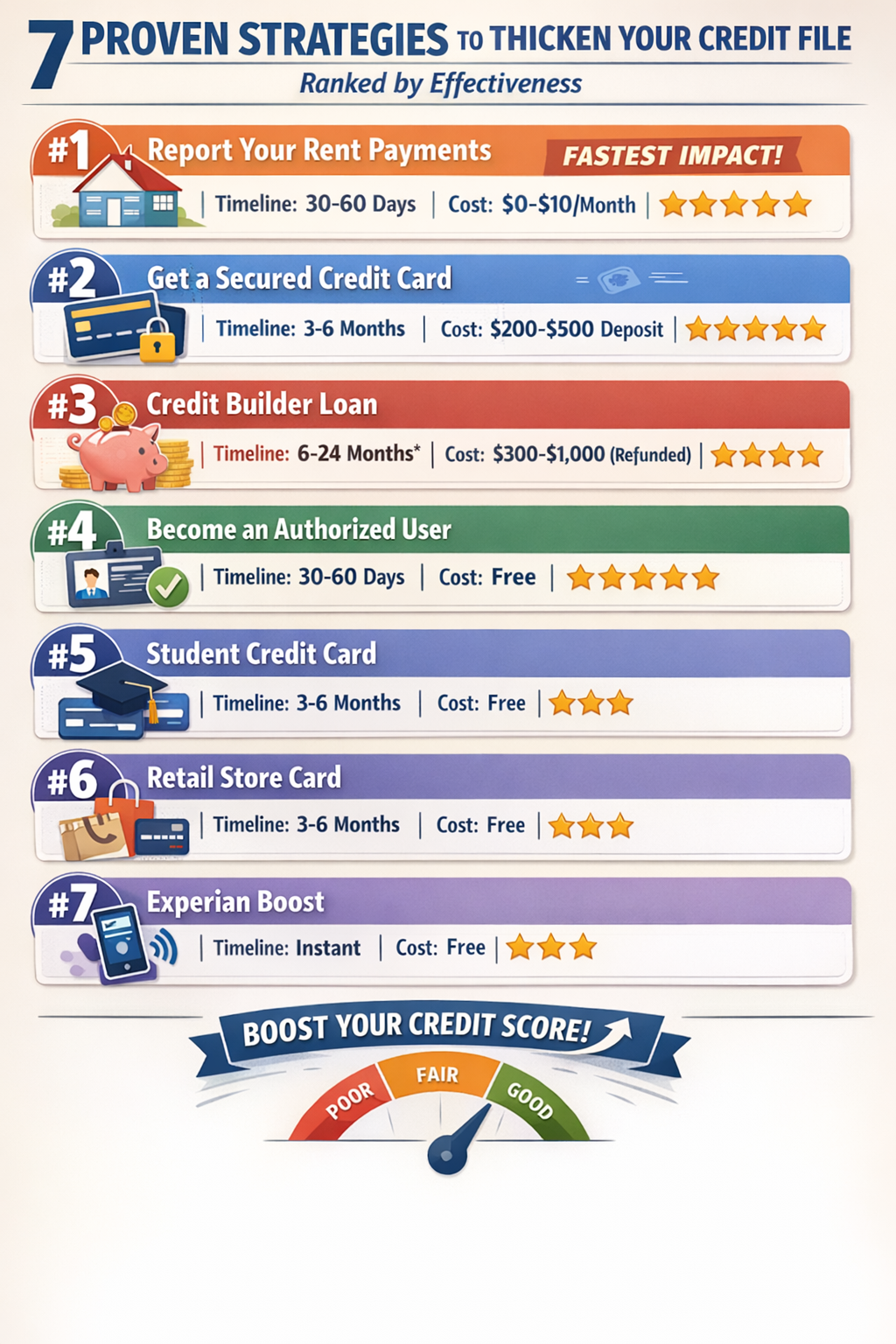
7 Proven Strategies to Thicken Your Credit File (Ranked by Effectiveness)
Here’s how to go from thin to thick credit, ranked by impact and speed:
Strategy #1: Report Your Rent Payments (Fastest Impact)
Effectiveness: ⭐⭐⭐⭐⭐ | Timeline: 30-60 days | Cost: $0-$10/month
Why pay $2,000 a month for years and get zero credit for it? Rent reporting is the fastest way to add a heavy-hitting tradeline. How Reporting Rent Can Boost Your Credit Score explains exactly how to turn your largest expense into your best asset.
How it works:
- Sign up with a rent reporting service (AxcessRent, RentTrack, Boom, etc.)
- They verify your rental history
- Your on-time rent payments get reported to credit bureaus
- Bonus: Many services let you report 12-24 months of past payments for an instant boost
Why this works so well: Rent is typically your largest monthly payment. Adding it to your credit report instantly shows consistent payment history without taking on new debt. Services like AxcessRent are free and report to all three bureaus.
Expected impact: 35-60 point credit score increase for people with thin files within the first reporting cycle.
Strategy #2: Get a Secured Credit Card
Effectiveness: ⭐⭐⭐⭐⭐ | Timeline: 3-6 months | Cost: $200-500 deposit (refundable)
Secured credit cards are specifically designed for people with thin or no credit.
How it works:
- You deposit $200-500 into a secured savings account
- The card issuer gives you a credit limit equal to your deposit
- Use the card for small monthly purchases
- Pay the balance in full each month
- After 6-12 months of on-time payments, many issuers ‘graduate’ you to an unsecured card and return your deposit
Best secured cards (2026): Discover it® Secured, Capital One Platinum Secured, Citi® Secured Mastercard®
Strategy #3: Credit Builder Loan
Effectiveness: ⭐⭐⭐⭐ | Timeline: 6-24 months | Cost: ~$300-1,000 (you get back)
These loans are specifically designed to build credit. You don’t receive the money upfront—instead, you make payments into a locked savings account. Think of this as a “forced savings” account that reports to the bureaus. You pay monthly, the bank holds the money, and at the end, you get the cash back plus a boost to your Length of Credit History.
How it works:
- Credit union or bank deposits $500-1,000 into a locked account in your name
- You make monthly payments (typically $25-100) for 6-24 months
- Payments are reported to credit bureaus as an installment loan
- At the end of the loan term, you get the full amount back (minus small interest/fees)
Dual benefit: You’re building credit AND savings at the same time.
Strategy #4: Become an Authorized User
Effectiveness: ⭐⭐⭐⭐ | Timeline: 30-60 days | Cost: Free
If a family member or trusted friend has excellent credit, ask them to add you as an authorized user on their credit card. Their positive payment history will appear on your credit report—instantly thickening your file.
Strategy #5: Student Credit Card (If Eligible)
Effectiveness: ⭐⭐⭐ | Timeline: 3-6 months | Cost: Free
If you’re in school, these cards have lower entry barriers. If you’re worried about how student debt plays into this, check out Does Student Loan Debt Affect Your Credit Score?.
Strategy #6: Retail Store Credit Card
Effectiveness: ⭐⭐⭐ | Timeline: 3-6 months | Cost: Free
Stores like Target or Amazon are often more willing to take a chance on a thin file. Just keep your Credit Card Utilization low—never max these out.
Strategy #7: Experian Boost (Free Alternative Data)
Effectiveness: ⭐⭐ | Timeline: Instant | Cost: Free
Experian Boost lets you add utility, phone, and streaming service payments to your Experian credit report. It’s free and instant, but only affects your Experian score (not TransUnion or Equifax). Impact is typically 10-15 points.
Timeline: How Long Does It Take to Go From Thin to Thick Credit?
Building a thick credit file doesn’t happen overnight, but you can see progress faster than you think:
| Timeline | What Happens | Action Items |
| Month 1 | First tradeline appears on credit report | Sign up for rent reporting + secured card |
| Months 2-3 | Credit score generated (if previously unscorable) | Make all payments on time, keep utilization under 30% |
| Months 4-6 | Score improves 30-60 points; file still thin but scorable | Consider adding credit builder loan or authorized user status |
| Months 7-12 | 3-4 tradelines established; file transitioning to thick | May qualify for unsecured credit card or small personal loan |
| 12+ Months | 5+ active accounts = thick credit file; score 680-720+ | Qualify for competitive rates on auto loans, mortgages |
5 Common Mistakes That Keep Your Credit File Thin
Even when actively trying to build credit, people make these errors:
1. Opening Too Many Accounts Too Fast
Applying for 5 credit cards in one month will hurt your score with hard inquiries and make lenders suspicious. Add accounts gradually—1-2 every 6 months.
2. Only Using Debit Cards
Debit cards don’t build credit, no matter how responsibly you use them. You must have actual credit accounts (cards, loans) that report to bureaus.
3. Ignoring Rent as a Tradeline
Most people don’t realize rent can be reported. If you’re already renting, this is literally free credit building you’re missing out on.
4. Closing Old Accounts
Once you finally build some tradelines, don’t close them. Length of credit history matters. Keep old accounts open (even if you don’t use them much) to maintain a longer average account age.
5. Not Checking Credit Reports for Errors
Sometimes accounts you DO have aren’t being reported properly. Check your credit reports at AnnualCreditReport.com every 4 months to ensure all your accounts are showing up correctly. If an account isn’t reporting correctly, you must act. Learn what to do if you Found an Error on Your Credit Report.
Frequently Asked Questions About Thin Credit Files
How many accounts do I need to have a thick credit file?
Generally, 5 or more active credit accounts (credit cards, loans, etc.) is considered a thick file. However, quality matters more than quantity—5 accounts with perfect payment history is better than 10 accounts with late payments.
Can I get a mortgage with a thin credit file?
It’s difficult but not impossible. FHA loans allow for alternative credit documentation (rent, utilities, insurance payments). However, you’ll likely face higher interest rates and stricter requirements. It’s better to thicken your file first with 12+ months of credit building.
Will paying off my student loans thin my credit file?
Yes, temporarily. When you pay off and close an installment loan, it removes an active tradeline. However, the paid-off loan stays on your report for 10 years, contributing to your credit history. The benefit of being debt-free usually outweighs the temporary thin file effect.
How long do accounts need to be active to count toward thickening my file?
An account is considered active if it’s open and has been used or reported within the past 6-12 months. Old accounts with no recent activity may become ‘stale’ and contribute less to your file thickness.
Is it better to have more credit cards or more loans?
A mix is best. Credit scoring models like to see both revolving credit (credit cards) and installment loans (auto, personal, mortgage). Aim for 2-3 credit cards and 1-2 loans over time for optimal credit mix.
Start Thickening Your Credit File Today
If you have a thin credit file, you have options. The fastest way to add a tradeline without taking on debt? Report your rent payments.
AxcessRent’s free plan reports your rent payments to all three major credit bureaus—Experian, TransUnion, and Equifax. You can even report up to 24 months of past rent payments for an instant credit boost.
| Ready to Thicken Your Credit File? Sign up for AxcessRent’s free plan and start building credit with your rent payments today. No credit card required. Reports to all three credit bureaus. Setup takes less than 10 minutes. Start Building Credit for Free → |
—
Last Updated: February 2026 | Sources: CFPB, Experian, TransUnion