
What Happens After Car Repossession? Timeline, Credit Impact, and Next Steps
A vehicle or car repossession is a significant financial setback, but it is not a permanent barrier to vehicle ownership or financial stability. Understanding the timeline of the process and the mechanics of credit recovery is the first step toward getting back behind the wheel.
1. How Does Repossession Work?
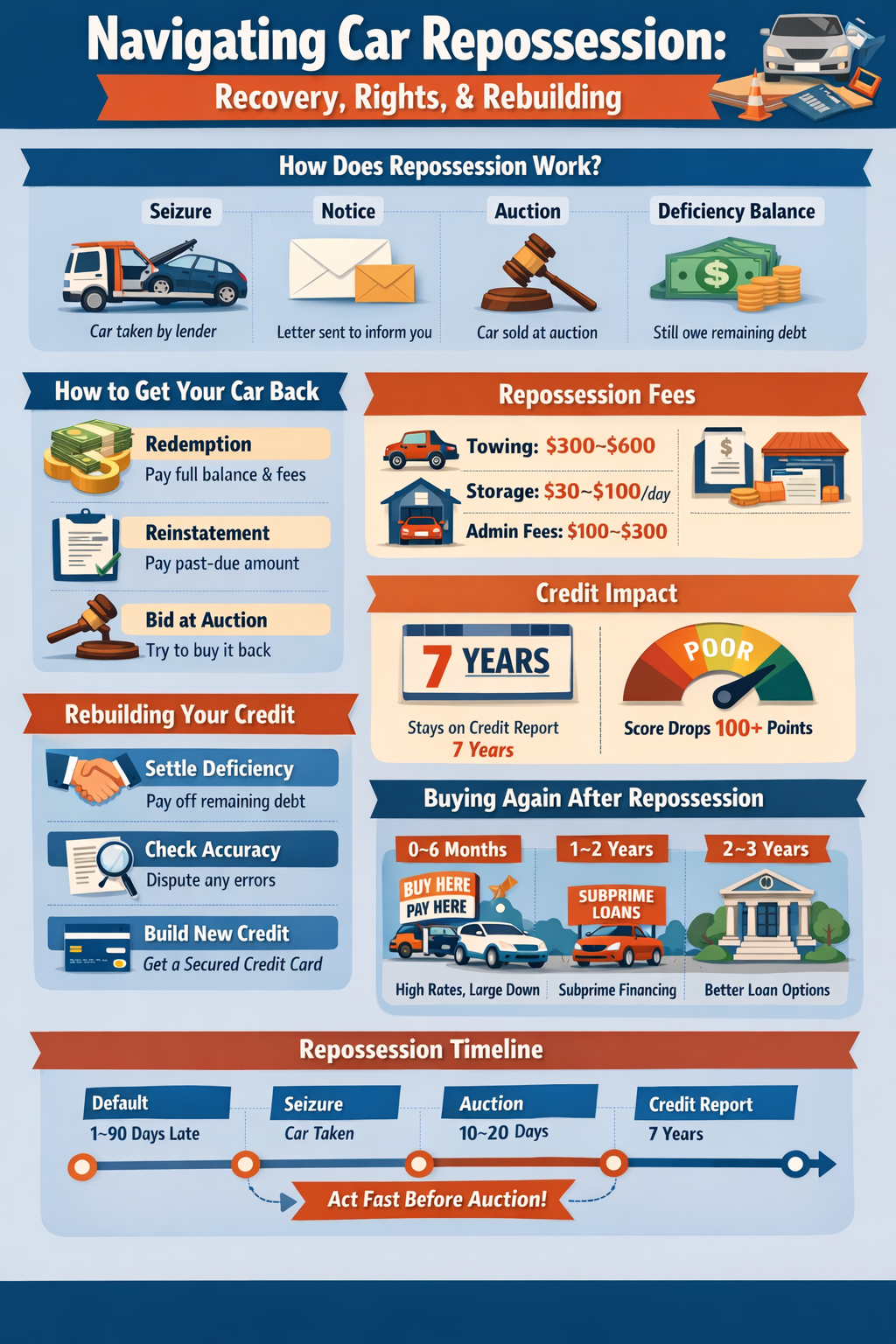
Repossession occurs when a borrower defaults on their auto loan contract. In many states, a lender can begin the process as soon as you are one day late on a payment, though most wait 60 to 90 days.
- The Seizure: Most states allow “self-help” repossession, meaning the lender can take the car from your driveway or a public lot without a court order, provided they do not “breach the peace” (e.g., breaking into a locked garage or using physical force).
- The Notice: After the car is taken, the lender must send you a notice explaining what happened and what your options are to recover the vehicle.
- The Sale: The lender will typically sell the car at a wholesale auction to recover their losses.
- The Deficiency Balance: If the car sells for $5,000 but you owed $8,000, you are still legally responsible for the $3,000 difference, plus repossession fees.
2. Can You Get Your Car Back After Repossession?
Yes, but the window of opportunity is small—usually 10 to 15 days before the car is sent to auction. There are generally three ways to do this:
- Redemption: Paying off the entire remaining loan balance plus all repossession and storage fees.
- Reinstatement: Paying only the past-due amount and fees to “catch up” the loan. Note: Not all states or contracts allow for reinstatement.
- Bidding at Auction: You have the right to know when and where the car will be auctioned, and you can technically bid on it there, though you must have the cash or a new loan ready.
Common Repossession Fees
When reclaiming a car, expect to pay:
- Towing/Recovery Fee: $300 – $600
- Storage Fee: $30 – $100 per day
- Administrative/Legal Fees: $100 – $300
3. Credit Impact: How Long Does It Last?
A repossession is one of the most damaging marks on a credit report, alongside bankruptcy and foreclosure.
- Duration: A repossession stays on your credit report for 7 years from the date of the first missed payment that led to the default.
- The Impact: Your score will likely drop by 100 points or more immediately. Over time, the impact lessens, especially if you build new, positive credit history.
4. How to Fix Your Credit After Repossession
Rebuilding requires a proactive approach to offset the “negative weight” of the repo.
- Settle the Deficiency: If you don’t pay the remaining balance after the auction, the account will be sent to collections, creating a second negative mark. Negotiate a “Settlement in Full” to stop further damage.
- Check for Inaccuracies: Ensure the lender reported the dates and balances correctly. If they breached the peace during seizure or failed to send required notices, you may be able to dispute the entry.
- Add Positive Trade-lines: Open a secured credit card or a credit-builder loan. On-time payments on these new accounts will gradually pull your score upward.
5. How Soon After Repossession Can I Buy a Car?
While you can technically buy a car immediately after repossession, your options will be limited and expensive.
- Immediate (0-6 Months): You will likely be restricted to “Buy Here, Pay Here” dealerships. These lots don’t always check credit but charge interest rates of 20-30% and require large down payments.
- The “Subprime” Window (1-2 Years): After a year of rebuilding your credit, you may qualify for “subprime” lending at traditional dealerships. You will still pay a high rate, but it will be lower than a predatory lot.
- Full Recovery (2-3 Years): If you have maintained perfect payment history on other bills since the repo, many mainstream lenders will consider you again, provided the repo balance is settled.
6. Summary Timeline of the Process
| Stage | Timing |
|---|---|
| Default | 1–90 days past due |
| Seizure | Can happen anytime after default |
| Notice of Intent to Sell | Within 5 days of seizure |
| Auction Sale | Usually 10–20 days after seizure |
| Credit Reporting | Updates within 30 days of sale |
| Credit Removal | 7 years from the original delinquency |
Conclusion
A repossession is a hurdle, not a dead end. By understanding your rights—such as the right to retrieve personal belongings from the car and the right to a fair auction—you can manage the immediate crisis. By focusing on settling the deficiency and building new credit, you can return to standard financing within a few years.
Frequently Asked Questions (FAQ)
1. Can I stop a repossession by hiding the car?
No. While it might delay the inevitable, hiding the car can be considered “hindering a secured creditor,” which may be a crime in some states. It also increases the lender’s costs, which they will eventually pass on to you as extra fees.
2. Does a voluntary repossession hurt my credit less?
No. Both voluntary and involuntary repossessions are reported the same way on your credit report. However, a voluntary surrender may save you money on towing and recovery fees.
3. Can a lender repossess my car if I’m only one day late?
Technically, yes. Most contracts state that you are in default the moment a payment is missed. However, most lenders prefer to avoid the cost of repossession and will wait 30-90 days while trying to contact you.
4. What happens to my personal belongings inside the car?
The lender cannot keep your personal property (like a laptop or clothes) found inside the vehicle. They must allow you to retrieve these items, though they may charge a small convenience fee for storage.
5. Can they take the car if it’s in a locked garage?
Generally, no. Repo agents cannot break into a locked building or “breach the peace.” If they do, the repossession may be considered illegal.
6. Will my insurance company find out about the repossession?
Insurance companies don’t typically see repossession on your credit report immediately, but they may notice if the lienholder (lender) cancels the policy or if they run a credit check at your next renewal.
7. Can the lender sue me after taking the car?
Yes. If the car sells at auction for less than what you owe, the lender can sue you for the “deficiency balance” and may even garnish your wages to collect it.
8. Can I remove a repossession from my credit report early?
Only if the information is inaccurate or if the lender failed to follow state laws during the process. If the repo was legitimate and followed the law, it will stay for the full 7 years.
9. Do I still have to pay the loan if the car was repossessed?
Yes. You are responsible for the loan balance until it is paid off, regardless of whether you still possess the vehicle.
10. What is the “Right of Redemption”?
This is a legal right in most states that allows you to buy back the vehicle by paying the full balance plus fees before the car is sold at auction.