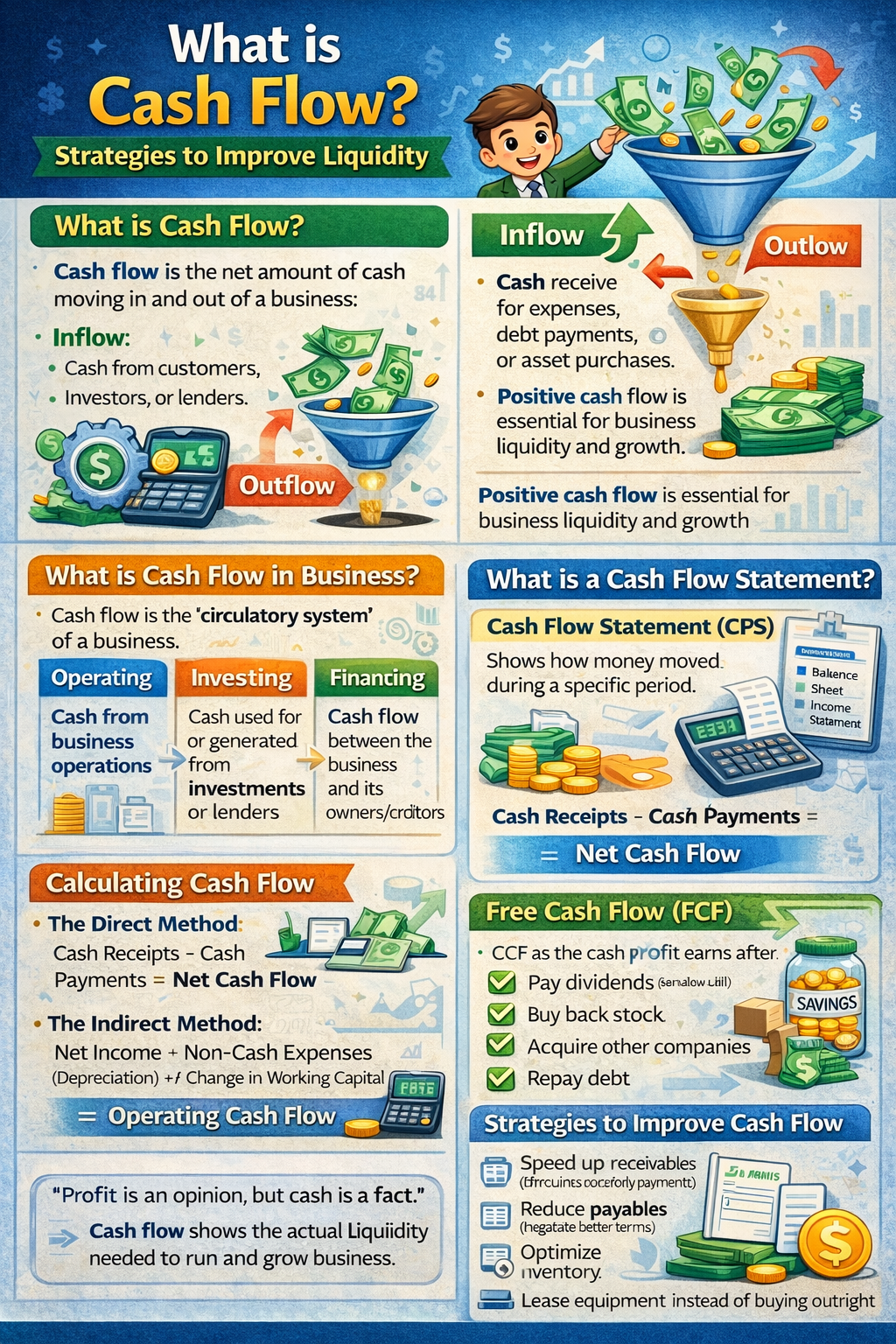
What is Cash Flow? Strategies to Improve Liquidity
In the world of finance, there is an old adage: “Profit is an opinion, but cash is a fact.” While a business can report a profit on its income statement, it can still go bankrupt if it doesn’t have the liquid capital to pay its bills. This guide breaks down everything you need to know about cash flow, from the basic definition to the complexities of the Cash Flow Statement.
1. What is Cash Flow?
At its simplest, cash flow is the net amount of cash and cash equivalents being transferred into and out of a business.
- Inflow: Cash received from customers, investors, or lenders.
- Outflow: Cash paid out for operating expenses, debt payments, and asset purchases.
Positive cash flow indicates that a company’s liquid assets are increasing, enabling it to settle debts, reinvest in its business, return money to shareholders, and provide a buffer against future financial hurdles.
2. What is Cash Flow in Business?
In a business context, cash flow is the “circulatory system” of the enterprise. It is distinct from “profit” because of accrual accounting. For example, if you sell $10,000 worth of products on credit, your profit increases immediately, but your cash flow doesn’t change until the customer actually pays the invoice.
Business cash flow is generally categorized into three types:
- Operating Cash Flow: Cash generated by core business activities.
- Investing Cash Flow: Cash used for or generated from investments and long-term assets (like buying machinery).
- Financing Cash Flow: Cash flow between a business and its owners/creditors (like issuing stock or paying dividends).
3. What is a Cash Flow Statement?
The Cash Flow Statement (CFS) is one of the three mandatory financial statements (alongside the Balance Sheet and Income Statement). It acts as a bridge between the income statement and the balance sheet by showing how money moved during a specific period.
It eliminates the “noise” of non-cash accounting entries like depreciation and amortization, providing a clear picture of whether a company is actually generating enough cash to stay solvent.
4. How to Calculate Cash Flow
There are two primary methods for calculating the total cash flow of a business:
The Direct Method
This adds up all the various types of cash payments and receipts, including cash paid to suppliers, cash receipts from customers, and cash paid out in salaries.
- Formula:
Cash Receipts - Cash Payments = Net Cash Flow
The Indirect Method
This is the most common method used by accountants. It starts with Net Income from the income statement and adjusts for non-cash items and changes in working capital.
- Formula:
Net Income + Non-Cash Expenses (Depreciation) +/- Changes in Working Capital = Operating Cash Flow
5. What is Free Cash Flow (FCF)?
Free Cash Flow is arguably the most important metric for investors. It represents the cash a company generates after accounting for cash outflows to support operations and maintain its capital assets.
Unlike earnings or net income, FCF is a measure of profitability that excludes the non-cash expenses of the income statement and includes spending on equipment and assets as well as changes in working capital from the balance sheet. It is the “free” cash available for the company to use for things like:
- Paying dividends to shareholders.
- Buying back stock.
- Acquiring other companies.
- Reducing debt.
6. How to Calculate Free Cash Flow
Calculating FCF requires data from both the Income Statement and the Cash Flow Statement.
The Standard Formula:
FCF = Operating Cash Flow − Capital Expenditures (CapEx)
- Operating Cash Flow: Found on the Cash Flow Statement; represents cash from normal business operations.
- Capital Expenditures: The money spent on purchasing or maintaining fixed assets (found in the Investing section of the CFS).
The “Net Income” Formula:
If you only have the income statement and balance sheet, you can use:
FCF = Net Income + Depreciation/Amortization − Change in Working Capital − CapEx
Summary Comparison Table
| Term | Complexity | Focus | Key Use |
|---|---|---|---|
| Cash Flow | Easy | Total movement of money | Daily liquidity management |
| Cash Flow Statement | Hard | Financial reporting/Structure | Regulatory compliance & deep analysis |
| Free Cash Flow | Medium | Available surplus | Valuation and investment analysis |
Understanding these metrics allows business owners to move beyond “looking profitable” to becoming truly “financially healthy.”
What is discounted cash flow ?
Discounted cash flow is a way to figure out what an investment is worth today. You take future cash flows, discount them back using a rate, and add them up.
What is Operating cash flow ?
Operating cash flow is the cash a company makes from its normal business operations. It shows how much money comes in from selling goods or services, after paying operating costs.
What is Net cash flow ?
Net cash flow is the total change in cash during a period. It’s cash from operations, plus investing and financing activities. Positive means more cash in than out.
Summary
Cash flow is the lifeblood of any business, representing the actual movement of currency in and out of the company. While Net Income tells you how much profit you’ve theoretically earned, the Cash Flow Statement tells you if you have the actual liquid funds to survive. Mastering Free Cash Flow (FCF) is the “gold standard” for understanding a company’s true value, as it shows what is left over for growth and shareholders after all bills and equipment upgrades (CapEx) are paid.
Frequently Asked Questions (FAQs)
1. Can a company be profitable but have negative cash flow?
Yes. This is common in fast-growing businesses. A company might record a “profit” by selling many goods on credit (Accounts Receivable), but if the customers haven’t paid yet, the company won’t have the cash to pay its own bills.
2. What is the difference between Operating Cash Flow and Free Cash Flow?
Operating Cash Flow (OCF) is the money generated strictly from business activities (like selling shoes). Free Cash Flow (FCF) takes OCF and subtracts the money spent on “Capital Expenditures” (like buying a new shoe factory). FCF is what is truly “free” to spend.
3. Why is depreciation added back when calculating cash flow?
Depreciation is an “accounting expense” used to spread the cost of an asset over its life, but no actual cash leaves the bank account when depreciation is recorded. Therefore, we add it back to Net Income to see the real cash position.
4. What is “Positive Working Capital” in the context of cash flow?
Working Capital is the difference between current assets and current liabilities. If you increase your inventory (an asset), your cash flow actually decreases because you spent cash to buy that stock.
5. Is a negative cash flow always a bad sign?
Not necessarily. If a company has negative cash flow because it is investing heavily in new equipment, research, or expanding into new markets, it may be a sign of future growth. However, negative operating cash flow over a long period is usually a major red flag.
6. How often should a business perform a cash flow analysis?
While large corporations report quarterly, small to medium businesses should monitor their cash flow weekly or monthly to ensure they can meet payroll and supplier obligations.
7. What is the “Cash Burn Rate”?
This is a term common in startups. It refers to the rate at which a company is spending its venture capital (cash reserves) before it starts generating a positive cash flow from operations.
8. How can I improve my business’s cash flow quickly?
Common strategies include:
- Speeding up collections (offering discounts for early payment).
- Slowing down payables (negotiating longer terms with suppliers).
- Reducing excess inventory.
- Leasing equipment instead of buying it outright.