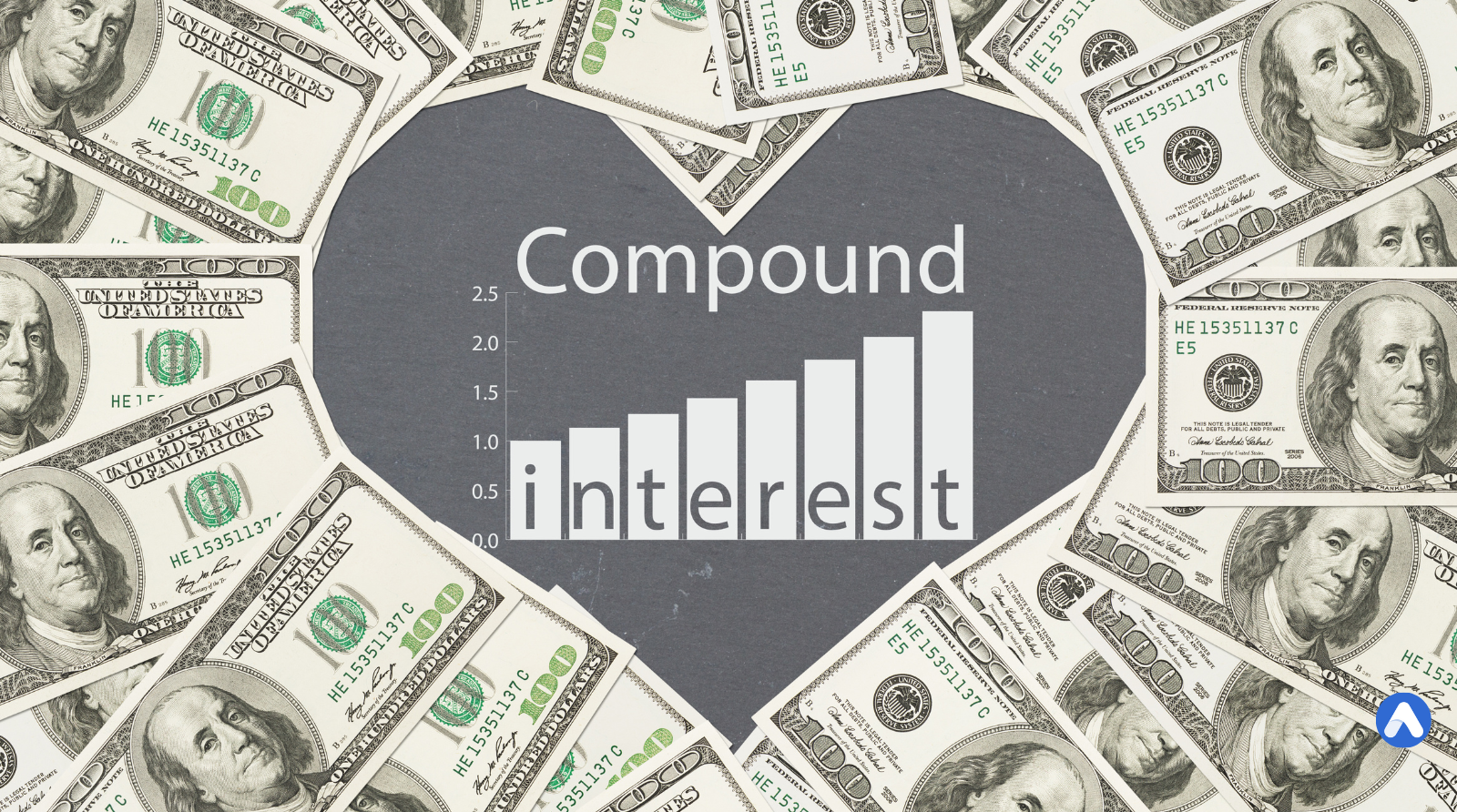
What is Compound Interest? A Step-by-Step Guide to Growing Your Money
Compound interest is one of the most powerful tools in personal finance and investing. It’s often called “the eighth wonder of the world” because of the incredible effect it has on growing your wealth over time. Understanding compound interest is essential for anyone who wants to make their money work for them, whether you’re saving for retirement, a down payment on a home, or building a financial safety net.
In this guide, we’ll explain what compound interest is, how it works, how to calculate it, and why starting early is so important. We’ll also cover common questions and practical tips to make compounding work for you.
What is Compound Interest?
Compound interest is the interest you earn on your initial investment (principal) plus the interest that accumulates over time. Unlike simple interest, which is only calculated on your original principal, compound interest allows your money to grow exponentially.
Think of it as “interest on interest.” Every time interest is added to your account, that new balance earns more interest in the next period. Over years and decades, this compounding effect can dramatically increase your savings.
Simple Example of Compound Interest
Suppose you deposit $1,000 in a savings account with a 5% annual interest rate.
- Year 1: Earn $50 interest → total $1,050
- Year 2: Earn $52.50 interest (5% of $1,050) → total $1,102.50
- Year 3: Earn $55.13 interest → total $1,157.63
Notice how the interest grows each year because it’s calculated on a larger amount than the year before.
How Does Compound Interest Work?
Compound interest grows your money over time by reinvesting your interest. The more often interest is compounded, the faster your money grows. Common compounding frequencies include:
- Annually: Interest is added once per year
- Semi-Annually: Interest is added twice per year
- Quarterly: Interest is added four times per year
- Monthly: Interest is added twelve times per year
- Daily: Interest is added every day
Compound Interest Formula
The standard formula for compound interest is:
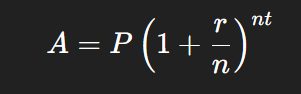
Where:
- A = the ending amount (future value)
- P = principal (initial investment)
- r = annual interest rate (decimal)
- n = number of times interest is compounded per year
- t = number of years
Example:
Deposit $5,000 at 5% interest, compounded monthly for 5 years:
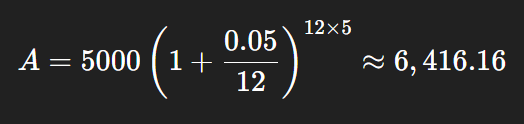
Your $5,000 grows to $6,416.16, earning $1,416.16 in interest.
How to Calculate Compound Interest
Calculating compound interest may seem intimidating, but it’s straightforward when broken into steps:
- Identify the principal (P): The initial amount you’re investing or saving.
- Determine the interest rate (r): Expressed as a decimal (e.g., 5% = 0.05).
- Choose compounding frequency (n): Monthly, quarterly, or annually.
- Decide the investment period (t): The number of years your money will grow.
- Apply the formula: Use A=P(1+r/n)ntA = P (1 + r/n)^{nt}A=P(1+r/n)nt or an online compound interest calculator for quick results.
Example with Monthly Contributions
Let’s say you invest $10,000 in a savings account at 4% annual interest, compounded monthly, and add $100 every month for 10 years:
- Principal (P) = $10,000
- Rate (r) = 4% = 0.04
- Compounding (n) = 12 months
- Time (t) = 10 years
- Monthly contribution = $100
After 10 years, the total balance would grow to approximately $29,647.91, earning $7,647.91 in interest on total deposits of $22,000. This demonstrates the power of combining consistent contributions with compounding.
Try Our Compound Interest Calculator
Understanding compound interest is easier when you can see it in action. Use our interactive calculator below to estimate how your savings or investments can grow over time. Enter your principal, interest rate, duration, and compounding frequency to see the power of compound interest in real time.
Compound Interest Calculator
How to Use This Calculator
- Enter the principal — the amount of money you’re starting with.
- Add the annual interest rate (as a percentage).
- Enter the number of years you plan to let your money grow.
- Select how often the interest compounds (annually, monthly, daily, etc.).
- Click Calculate to see your compound interest and total amount.
This interactive section helps readers instantly visualize how compound interest grows wealth, making your article more engaging and shareable.
Simple vs. Compound Interest
Understanding the difference between simple and compound interest is crucial.
Simple Interest
- Calculated only on the principal.
- Example: $1,000 at 5% annual simple interest for 3 years = $150 → total $1,150
Compound Interest
- Calculated on principal + accumulated interest.
- Example: $1,000 at 5% annual compound interest for 3 years = $1,157.63
Compound interest always grows faster than simple interest, especially over long periods, making it the preferred method for savings and investment growth.
How the Age You Start Saving Impacts Compound Interest
Time is a major factor in compound interest. The earlier you start saving, the more time your money has to grow exponentially.
Example:
- Start at 20: Save $100/month at 6% for 20 years → ~$52,000
- Start at 30: Save $100/month at 6% for 20 years → ~$34,000
Starting just 10 years earlier adds nearly $18,000, showing why starting early is key to financial success.
Practical Ways to Use Compound Interest
1. High-Yield Savings Accounts
Look for accounts that offer competitive APYs. Compounded daily or monthly, these accounts help your savings grow faster than standard checking accounts.
2. Retirement Accounts (IRAs & 401(k)s)
These accounts take advantage of decades of compounding, especially when you reinvest dividends. Even small contributions grow significantly over time.
3. Investments (Stocks, ETFs, Mutual Funds)
Reinvesting returns in the stock market can compound your wealth over years. Historically, diversified portfolios return an average of 6–7% annually.
4. Rent Reporting and Financial Tools
Services like AxcessRent help you build credit, which indirectly impacts financial health, enabling access to better loan rates and investment opportunities that benefit from compounding.
Common Questions About Compound Interest
Q1: What is compound interest?
Compound interest is interest earned on your principal plus previously earned interest, allowing your money to grow faster than with simple interest.
Q2: How to calculate compound interest?
Use the formula A=P(1+r/n)ntA = P (1 + r/n)^{nt}A=P(1+r/n)nt or a reliable online calculator to find your investment growth over time.
Q3: How does starting age affect compound interest?
The earlier you start saving, the more time compounding has to work, leading to significantly higher balances.
Q4: What is the difference between simple and compound interest?
Simple interest is calculated only on principal; compound interest is calculated on principal plus accumulated interest.
Q5: Can you build wealth with compound interest alone?
Yes! With consistent savings and time, compound interest can significantly grow your wealth even without additional investments.
Q6: How does compound interest work in real life?
It works in savings accounts, retirement accounts, and investments, where interest or returns are reinvested, allowing growth to accelerate over time.
Q7: How do you find compound interest?
Either use the formula A=P(1+r/n)ntA = P (1 + r/n)^{nt}A=P(1+r/n)nt or a compound interest calculator for precise results.
Tips to Maximize Compound Interest
- Start early: Even small contributions grow substantially over decades.
- Increase contributions: Add more money regularly to boost compounding.
- Choose higher interest rates: Look for competitive savings accounts or investments.
- Reinvest returns: Never withdraw interest; let it compound.
- Be consistent: Time and consistency are more important than large one-time deposits.
Conclusion
Compound interest is one of the most effective ways to grow your wealth over time. It’s not just about earning interest; it’s about earning interest on interest, which can turn modest savings into significant financial growth.
Whether you’re using a high-yield savings account, investing in mutual funds, or contributing to a retirement account, understanding compound interest and starting early can make a dramatic difference in your financial future.
Remember, time is your greatest ally — the earlier you start, the more powerful compounding becomes. By using these principles and staying consistent, you can achieve long-term financial stability and growth.