
Accrued Expenses, Interest, and Revenue: A Clear Guide to Accrual Accounting
1. What Does “Accrued” Mean?
In simple terms, “accrued” means built up over time.
When you hear “accrued expenses,” it means the expense has happened, but you haven’t yet paid for it.
When you hear “accrued revenue,” it means you’ve earned income, but you haven’t yet received the cash.
For example:
- If your company used electricity all month but hasn’t yet received the utility bill, that’s an accrued expenses.
- If you finished a project for a client but haven’t sent the invoice yet, that’s accrued revenue.
- If you owe interest on a loan but the payment isn’t due until next month, that’s accrued interest.
Accrued items help accountants record transactions in the right period — even when cash hasn’t been paid or received.
2. Why Accountants Use Accrual Accounting
Businesses can use one of two systems:
- Cash accounting – record transactions only when money changes hands.
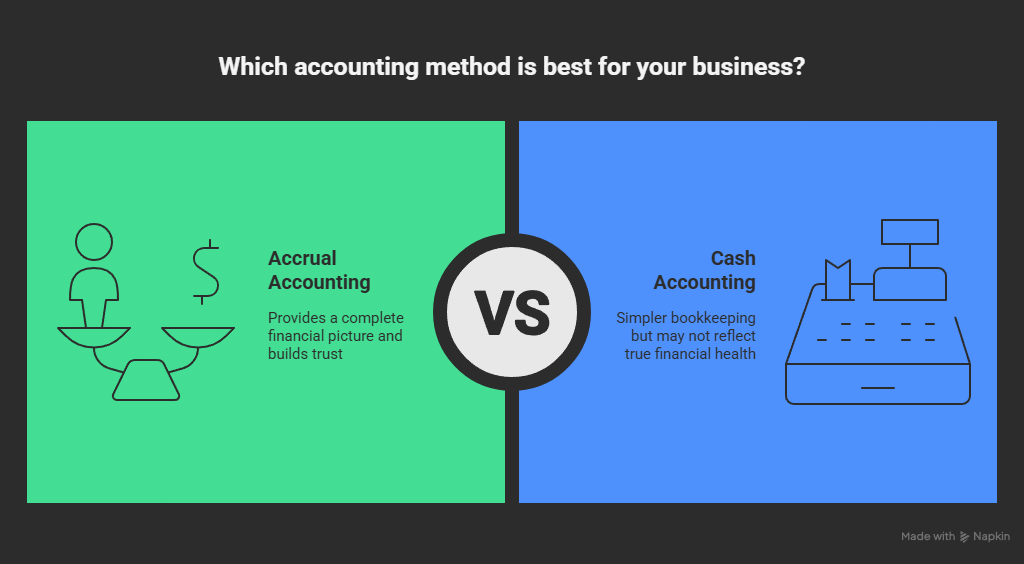
- Accrual accounting – record income when it’s earned and expenses when they’re incurred.
Accrual accounting gives a more accurate picture.
If you provide a service in March but get paid in April, accrual accounting records the revenue in March — when the work was done.
This method matches income with the expenses used to earn it, giving a fair view of profit.
That’s why most businesses, especially those that work with clients, lenders, or investors, use accrual accounting.
It’s also required by GAAP (Generally Accepted Accounting Principles).
3. Accrued Expenses Explained
An accrued expenses is something you owe but haven’t yet paid.
It’s a liability — a promise to pay later.
Common examples include:
- Wages for work already done but not yet paid
- Interest on loans
- Taxes due next month
- Utilities used but not yet billed
- Rent that covers the current month but will be paid next month
Let’s look at an example.
Example: Accrued Salaries
Your company’s employees worked through the last week of December, but payday falls in January.
Those unpaid wages are an accrued expense for December.
You’ll record:
- Debit: Salary Expense
- Credit: Salaries Payable
This shows that you owe money even though cash hasn’t left your account yet.
Accrued expenses keep your records honest — they show what you truly owe during the period, not just what’s been paid.
4. Accrued Liabilities
The term accrued liabilities refers to the same idea.
These are obligations a company has already incurred but hasn’t yet paid or received an invoice for.
Examples:
- Payroll taxes owed
- Employee bonuses
- Interest on loans
- Legal or professional fees incurred but not yet billed
These liabilities appear on the balance sheet under “Current Liabilities.”
They’re different from accounts payable because they don’t yet have an invoice.
They’re based on an estimate of what’s owed, recorded before a bill arrives.
5. Accrued Revenue
Now let’s flip the coin.
Accrued revenue is money earned but not yet received.
For example:
- A web designer finishes a project in June but doesn’t bill until July.
- A landlord accrues rent for June that the tenant will pay in July.
- A consulting firm completes its work but payment hasn’t arrived.
Example: Accrued Consulting Income
If you finished a $2,000 project in June, you’ll record:
- Debit: Accounts Receivable $2,000
- Credit: Service Revenue $2,000
This entry ensures June’s income reflects what you actually earned — not just what was paid. Accrued revenue is an asset because it represents future income.
6. Accrued Interest
Accrued interest builds up between the time you borrow money and the time you pay it back — or between the time you lend money and when you get paid.
If you borrow, it’s an expense.
If you lend, it’s income.
Example: Accrued Interest Expense
Say your company took a $10,000 loan with 10% annual interest, payable quarterly.
At the end of the first month, you’ve built up one month’s interest:
$10,000 × 10% ÷ 12 = $83.33
Even though you haven’t paid yet, you record:
- Debit: Interest Expense $83.33
- Credit: Interest Payable $83.33
That’s your accrued interest expense for the month.
7. The Difference Between Accrued and Deferred
These two words often confuse people.
Here’s the simple difference:
| Type | Meaning | Example |
|---|---|---|
| Accrued Expenses | You owe money for something already used | Utilities for December, billed in January |
| Accrued Revenues | You earned money for work done | Service completed, invoice not sent |
| Deferred Expenses | You paid in advance | Prepaid insurance |
| Deferred Revenues | You received payment in advance | Rent received for next month |
Think of accrued as record now, pay or receive later, and deferred as pay or receive now, record later.
8. How to Record Accruals
Here’s the basic process accountants follow:
- Identify what’s been earned or incurred but not yet recorded.
- Estimate the amount, based on invoices, contracts, or patterns.
- Record the journal entry using debit and credit accounts.
- Reverse the entry next period, once the cash transaction happens.
This process keeps financial statements consistent month to month.
9. The Matching Principle
The matching principle is the reason accrual accounting exists.
It says that expenses should be recorded in the same period as the revenues they help generate.
For example, if you buy raw materials in December but sell the product in January, the expense belongs to January — because that’s when the income appears.
Matching expenses and revenues helps prevent false profits or losses.
It also helps business owners see if they’re truly making money.
10. Real-World Example: Accrual Accounting in Action
- Imagine a small design studio that finishes a $5,000 website project on December 28 but invoices on January 5.
Under cash accounting, December looks quiet — no income.
Under accrual accounting, the $5,000 counts as December revenue, matching the work done. - Now add a December phone bill of $150 that arrives in January.
That’s an accrued expenses in December. - At year-end, the books show both income and expenses from the same period, giving a true reflection of profit.
That’s the power of accrual accounting.
11. Advantages of Accrual Accounting
- Provides a complete financial picture
- Matches income and related costs
- Helps manage obligations and cash flow planning
- Builds trust with investors and lenders
- Required by most accounting standards
Accrual accounting takes a little more effort, but it prevents surprises later.
12. Limitations of Accrual Accounting
- More bookkeeping work
- Requires judgment and estimates
- May show profits even when cash is tight
- Can confuse beginners without clear records
That’s why some small businesses start with cash accounting before switching as they grow.
13. Accruals and Financial Statements
Accrual entries affect three main reports:
Income Statement
- Accrued revenues increase income.
- Accrued expenses reduce income.
Balance Sheet
- Accrued revenues appear under assets (usually as “Accounts Receivable”).
- Accrued expenses appear under liabilities (like “Wages Payable”).
Cash Flow Statement
- These accruals adjust the “Net Income” section to reflect actual cash flow.
14. Accrued Liabilities vs Accounts Payable
It’s easy to confuse the two, but they’re slightly different.
| Feature | Accrued Liabilities | Accounts Payable |
|---|---|---|
| Basis | Estimated amount owed | Actual invoice received |
| Timing | Recorded before invoice arrives | Recorded after invoice |
| Example | Interest payable, salaries payable | Supplier bills |
Both are current liabilities, but accrued liabilities come first — when the cost is known but the paperwork hasn’t arrived.
15. Why Accruals Matter for Business Planning
Accruals help you understand what’s really happening behind the numbers.
Without them, your profit and loss statement might look better or worse than it really is.
For instance:
- If you delay recording accrued expenses, your profits look inflated.
- If you forget accrued revenue, you’ll understate income.
Getting this balance right helps you make informed decisions about spending, pricing, and investments.
16. Common Mistakes to Avoid
- Skipping reversal entries – this causes double-counting.
- Estimating inaccurately – use data or averages, not guesses.
- Confusing accrued and deferred entries.
- Forgetting small recurring items like utilities or interest.
Consistency matters. Good accrual tracking leads to cleaner, more reliable books.
17. Accrual Accounting in 2025 and Beyond
Today’s accounting software makes accruals simple.
Modern tools like QuickBooks, Xero, and Wave automatically record recurring expenses and adjust balances.
As more businesses move online, accrual accounting is essential for clear reporting, even for small startups.
It allows owners to forecast more accurately and track real performance, not just cash movement.
18. The Role of Auditors
Auditors pay close attention to accruals because they reveal how well a business manages timing.
They check whether accruals are consistent with invoices, contracts, and patterns from prior years.
Accrual adjustments can affect taxes, bonuses, and investor reports — so precision is key.
Getting it right builds credibility.
19. The Link Between Accruals and Cash Flow
While accrual accounting records income and expenses as they occur, it doesn’t show actual cash available. That’s why you still need to track cash flow separately. A company can look profitable on paper but run out of cash if too much income is tied up in receivables.
Accruals help predict when cash will move, making it easier to plan payments and collections.
20. Final Thoughts
Accruals are part of every serious accounting system. They bridge the timing gap between earning and paying — between effort and cash. When you understand accrued expenses, accrued interest, and accrued revenue, you see a clearer financial story. It’s about recognizing reality, not just movement in your bank account. Good accrual practices help you stay compliant, plan better, and make decisions based on accurate numbers. In accounting, that’s the difference between guessing and knowing.
Frequently Asked Questions
1. What does accrued mean in plain English?
It means something has been earned or owed but hasn’t yet been paid or received.
2. What’s an example of an accrued expense?
Unpaid wages, taxes, and interest that have built up but haven’t been paid yet.
3. What’s an example of accrued revenue?
Income earned from a completed service where the customer hasn’t yet paid.
4. Is accrued interest the same as interest expense?
Not exactly. Accrued interest is what’s built up but not paid yet; it becomes an expense when you pay it.
5. What are accrued liabilities?
Short-term debts that a business owes for expenses it’s already used, like payroll or taxes.
6. Why do we need accrual accounting?
It helps show the true financial performance of a business, even before money moves.
7. How is accrual accounting different from cash accounting?
Accrual accounting records events when they happen; cash accounting waits until money changes hands.
8. Is accrual accounting better for small businesses?
It depends. For simple cash-based businesses, it may not be necessary. For those with invoices, it gives a clearer picture.
9. What happens if you forget to record accruals?
Your profit and expenses will be misstated, which can cause reporting and tax problems.
10. What’s the easiest way to manage accruals?
Use accounting software that tracks invoices, bills, and recurring transactions automatically.