
How to Use Rent History for Job Applications ?
Applying for a job can feel daunting, especially if you’re a recent graduate, career changer, or someone with limited work experience. But your rent history—your record of paying rent on time—can be a powerful tool to showcase your reliability and financial responsibility. In 2025, with more employers using background and credit checks to assess candidates, leveraging your rent history can give you an edge. This comprehensive guide explains how to use rent history for job applications, why it matters, and how to avoid common mistakes. It’s packed with practical steps, real-world examples, and answers to trending queries like “Does rent history affect job applications?” and “How to get a rental reference for employment?”
Whether you’re applying for your first job or aiming for a role that requires financial trust, this guide will help you present your rent history effectively and boost your chances of landing the job.
What Is Rent History?
Rent history is a record of your rental payments and tenancy details. It includes:
- Addresses and Dates: Where you lived and for how long.
- Payment Records: Proof you paid rent on time, like bank statements or receipts.
- Landlord Feedback: Whether you followed lease terms, maintained the property, or had disputes.
- Credit Impact: If reported to credit bureaus via services like AxcessRent, your rent payments can improve your credit score.
For job applications, rent history acts like a reference. It shows employers you’re reliable and can manage commitments. In 2025, with 92% of employers conducting background checks (per SHRM), rent history is increasingly relevant, especially for roles involving money or trust.
Why Rent History Matters for Job Applications
Employers want candidates who are dependable, organized, and financially responsible. Rent history demonstrates these traits in several ways:
- Financial Responsibility: Paying rent on time—say, $1,200/month for two years—shows you manage money well, a key skill for jobs in finance, retail, or management.
- Consistency: A long-term lease (e.g., two years at one address) signals stability, reassuring employers you’re not likely to quit quickly.
- Character: A landlord’s reference can highlight how you handled issues, like requesting repairs politely, which reflects professionalism.
- Credit Building: Reporting rent payments through AxcessRent or Experian Boost can raise your credit score (e.g., from 550 to 650 in six months), which employers may check for roles requiring financial oversight.
For example, consider Jake, a 24-year-old applying for a bank teller position. With only one year of work experience, he included his landlord’s reference, confirming two years of on-time $1,000/month rent payments. The employer valued this proof of reliability and hired him over a candidate with a similar resume but no rental reference.
Rent history is especially useful for:
- Recent Graduates: With little work history, rent payments show real-world responsibility.
- Career Changers: It bridges gaps in employment history.
- Finance or Real Estate Jobs: Employers often check credit and rental records for these roles.
- Gig Workers: Freelancers with irregular income can use rent history to prove stability.
How Rent History Affects Job Applications
Does rent history affect job applications? Yes, it can. Employers use it to assess your reliability, especially in roles involving money or sensitive data. According to a 2025 TransUnion report, 70% of employers check credit for certain positions, and rent history often appears in these reports if reported to bureaus. A strong rent history can tip the scales in your favor, while a negative one (e.g., evictions) may raise concerns.
However, not all employers check rent history. It’s most common in:
- Government jobs (e.g., federal agencies requiring security clearances).
- Financial roles (e.g., accountants, bank tellers).
- Property management or real estate positions.
If you have no rent history, it’s neutral—it won’t hurt, but you miss a chance to stand out. Building a rent history with tools like AxcessRent can help future applications.
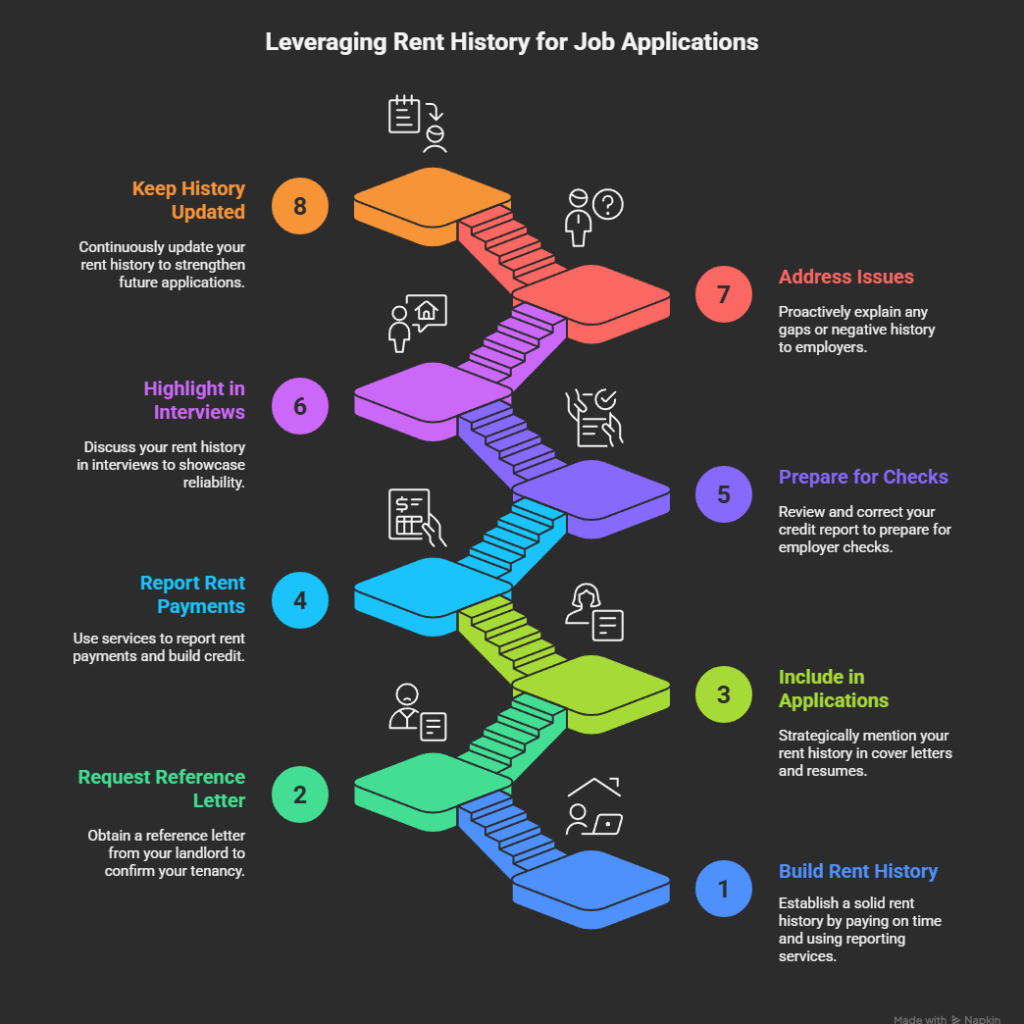
8-Step Guide to use Rent History for Job Applications
Here’s a detailed, actionable plan to leverage your rent history effectively. Follow these steps to make it a strength in your job search.
Step 1: Build and Document Your Rent History
Start by ensuring you have a solid rent history. Pay rent on time every month—late payments can hurt your record. Use a service like AxcessRent to report payments to credit bureaus (Equifax, Experian, TransUnion). This creates a formal record and boosts your credit score.
Collect these documents:
- Lease Agreements: Show rental terms and dates.
- Payment Proof: Bank statements, canceled checks, or AxcessRent reports.
- Landlord Contact Info: For references.
Tip: If you’re a new renter, ask your landlord if they report payments or use a service like AxcessRent from day one.
Mistake to Avoid: Not keeping payment records. Without proof, your claims lack weight.
Step 2: Request a Landlord Reference Letter
A landlord reference letter is a powerful tool. It confirms you paid rent on time and were a good tenant. Contact your current or past landlord via email or phone. Be polite and specific.
Sample Email:
Hi [Landlord’s Name],
I’m applying for jobs and would like to use my rent history from [Address] as a reference. I paid rent on time from [Start Date] to [End Date]. Could you provide a letter confirming this? I can send a template. Thank you!
[Your Name]
The letter should include:
- Your name and rental address.
- Lease dates (e.g., January 2023–December 2024).
- Confirmation of on-time payments.
- Notes on your tenancy (e.g., no damages, followed rules).
If your landlord agrees but doesn’t write letters, offer a template. If they refuse, use payment receipts or another reference (e.g., a roommate).
Mistake to Avoid: Not asking early. Give landlords a week to respond.
Step 3: Include Rent History in Job Applications
Most job applications don’t have a field for rent history. Instead, include it strategically:
- Cover Letter: Mention briefly. Example: “My consistent rent payments over two years demonstrate my financial responsibility, a skill I’ll bring to [Company Name].”
- Resume: If you lack work experience, add a short “Additional Experience” section. Example:
Rental History- Tenant at [Address], [City], [Dates] – Paid $1,200/month on time. Landlord reference available.
- Application Forms: If there’s a section for references or background info, list your landlord’s contact details.
Tip: Tailor this to the job. For financial roles, emphasize it more. For creative roles, keep it minimal.
Mistake to Avoid: Overloading your resume with rent details. Keep it concise.
Step 4: Report Rent Payments to Build Credit
Rent reporting services like AxcessRent or Experian Boost add your payments to credit reports. This can raise your score by 20–100 points in 6–12 months, depending on your starting point. A score above 670 impresses employers who check credit, like banks or government agencies.
How It Works:
- Sign up for AxcessRent ($5–$10/month for premium features).
- Your landlord verifies payments, or you upload proof.
- Payments are reported to bureaus, boosting your payment history (35% of FICO score).
Example: Maria, a 23-year-old, had no credit history. She used AxcessRent to report $1,000/month rent. In six months, her score rose from 550 to 620, helping her land a retail job.
Mistake to Avoid: Not checking if the service reports to all three bureaus. Limited reporting reduces impact.
Step 5: Prepare for Background and Credit Checks
Many employers run background checks, which may include rental and credit history. Be ready:
- Check Your Credit: Get a free report from AnnualCreditReport.com. Fix errors (e.g., unreported rent payments).
- Disclose Issues: If you have evictions or late payments, explain briefly. Example: “I had one late rent payment due to a medical emergency but have been consistent since.”
- Provide Accurate Info: List all rental addresses and dates on background check forms. Inconsistencies raise red flags.
Tip: Use AxcessRent reports as proof if your landlord’s records are incomplete.
Mistake to Avoid: Lying about your history. Employers verify claims.
Step 6: Highlight Rent History in Interviews
If an employer asks about reliability or financial skills, mention your rent history. Example: “I’ve paid rent on time for three years while managing a tight budget, which shows my ability to meet deadlines.”
Bring a copy of your landlord’s reference letter or AxcessRent report to the interview. It backs up your claims.
Tip: Practice your answer to sound natural, not rehearsed.
Mistake to Avoid: Overemphasizing rent history unless it’s relevant to the job.
Step 7: Address Gaps or Negative Rent History
If your rent history has issues, don’t hide them. Address them proactively:
- Late Payments: Explain the cause (e.g., job loss) and highlight recent consistency.
- Evictions: Be honest. Say, “I faced an eviction in 2022 due to unemployment, but I’ve maintained steady payments since.”
- No Rent History: If you lived with family or owned a home, use other references (e.g., employers, utility payments via Experian Boost).
Example: Alex had an eviction in 2023 but used AxcessRent to report two years of on-time payments afterward. He explained this in his cover letter and secured a customer service job.
Mistake to Avoid: Ignoring negative history. Employers will find it during checks.
Step 8: Keep Your Rent History Updated
As you rent longer, update your records. Add new landlords or payment proofs. If you move, get a reference letter before leaving. A longer, consistent rent history strengthens future applications.
Tip: Save digital copies of all documents in a folder for easy access.
Mistake to Avoid: Letting records lapse. Old references lose impact.
Benefits of Using Rent History for Job Applications
Leveraging rent history offers several advantages:
- Proves Reliability: On-time payments show you meet obligations, key for any job.
- Fills Resume Gaps: Ideal for young applicants or those with limited work history.
- Boosts Credit: Reporting rent raises your score, impressing employers who check credit.
- Provides Strong References: Landlords can vouch for your character, unlike generic references.
- Sets You Apart: In competitive fields, a unique angle like rent history makes you memorable.
For instance, a 26-year-old applicant with one year of work experience used her two-year rent history to land a property management job. Her landlord’s reference and improved credit score (from 580 to 650 via AxcessRent) sealed the deal.
Challenges and How to Overcome Them
Using rent history isn’t foolproof. Here are common challenges and solutions:
- Negative History: Late payments or evictions hurt. Solution: Explain the context and show recent improvements. Use AxcessRent to build a positive record.
- No Rent History: If you lived with family or own a home, use utility payments or personal references. Start renting with a reporting service.
- Unresponsive Landlords: Some won’t provide references. Solution: Use payment receipts or AxcessRent reports as proof.
- Privacy Concerns: Sharing financial details feels invasive. Solution: Only provide what’s needed and use secure services like AxcessRent.
- Limited Employer Interest: Not all jobs care about rent history. Solution: Focus on roles in finance, real estate, or government where it’s relevant.
Mistake to Avoid: Assuming all employers want rent history. Tailor its use to the job.
State-Specific Considerations for Rent Reporting
Rent reporting and tenant laws vary by state, which can affect how you use rent history:
- California: Strict tenant protections and rent control in cities like Los Angeles mean landlords may be cautious with references. Use AxcessRent to formalize your record.
- New York: High rental demand makes references competitive. A strong landlord letter stands out.
- Ohio: Flexible reporting rules make AxcessRent effective for credit building.
- Florida: No rent control simplifies reporting, but ensure landlords verify payments.
Check your state’s tenant handbook or consumer protection website for 2025 updates, as new laws may expand rent reporting options.
Tools and Resources for Using Rent History
These tools can help you leverage rent history effectively:
- AxcessRent: Reports rent payments to credit bureaus ($5–$10/month). Ideal for building a formal history.
- Experian Boost: Free tool to report rent and utility payments, boosting your credit score.
- Credit Karma: Free credit score tracking to monitor rent reporting impact.
- AnnualCreditReport.com: Free credit reports to verify reported payments and fix errors.
- NFCC.org: National Foundation for Credit Counseling offers job-related financial advice.
- Mint: Budgeting app to ensure on-time rent payments.
Conclusion
Using rent history for job applications is a smart move in 2025. It proves you’re reliable and financially responsible, especially for jobs in finance, real estate, or government. By following this 8-step guide—building a strong history, getting landlord references, and reporting rent via AxcessRent—you can strengthen your application and boost your credit score. Avoid mistakes like ignoring negative history or lying about payments. Start today by contacting your landlord for a reference and checking your credit at AnnualCreditReport.com. For more tips on using rent to build credit and career opportunities, visit AxcessRent. Your rent history could be the key to landing your dream job.
FAQs on Using Rent History for Job Applications
How to Use Rent History for Job Applications?
Collect lease agreements, payment receipts, and landlord contact info. Request a reference letter confirming on-time payments. Mention rent history in cover letters to show reliability. Use AxcessRent to report payments and boost credit. Be ready for background checks with accurate records.
Does Rent History Affect Job Applications?
Yes, it can. Employers check rent history via credit or background reports, especially for finance, real estate, or government jobs. On-time payments show reliability, while evictions may raise concerns. A strong history tips the scales in competitive applications.
Can Landlords Provide References for Jobs?
Yes. Landlords can confirm you paid rent on time and followed lease terms. Request a letter with your rental dates, payment history, and tenancy details. Provide a template to make it easy. List their contact info on applications.
How to Verify Rent History for Employment?
Employers verify through landlord references or credit reports. Provide accurate landlord contacts and lease details. Use AxcessRent reports as proof if needed. Check your credit report at AnnualCreditReport.com to ensure accuracy.
What If I Have Bad Rent History?
Explain issues like late payments or evictions in your cover letter (e.g., “One late payment due to job loss, but I’ve been consistent since”). Use recent payment records or AxcessRent to show improvement. Honesty is key.
Is Rent History on a Resume a Good Idea?
Not directly on the resume, but mention it in a cover letter or “Additional Experience” section if you lack work history. Example: “Paid $1,200/month rent on time for two years.” Keep it brief and relevant.
How Does Rent History Help Build Credit for Jobs?
Reporting rent via AxcessRent or Experian Boost adds positive payment history to your credit report, raising your score (e.g., 20–100 points in 6–12 months). A higher score (670+) impresses employers who check credit, especially in finance.
What If I Have No Rent History?
Use other references like employers, professors, or utility payment records via Experian Boost. Start building rent history with AxcessRent for future applications. Highlight other stability, like consistent part-time work.